
 Oct 22, 2026
"How long does the battery last" is the most common question about UAV power, and it hides two completely different questions. One is flight time: how long the aircraft stays in the air on a single charge. The other is lifespan: how many charge and discharge cycles the pack survives before its capacity drops to about 80% of the original figure. A pack can be excellent at one and mediocre at the other.
This guide separates the two, gives a practical way to estimate flight time from battery and motor data, explains what typically limits drone battery lifespan, and lists the handling rules that actually change the number. UFOPOWER is a professional lithium battery manufacturer supplying custom UAV packs, so the measurements below are the same ones used when sizing a pack for a customer's airframe.
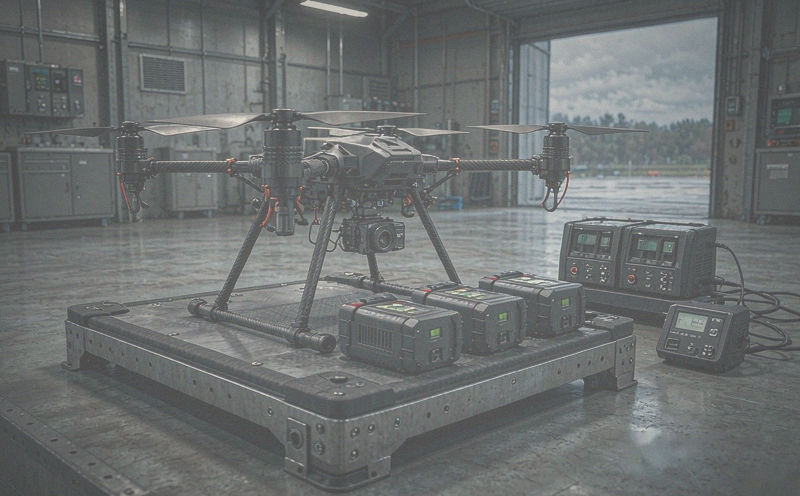
Flight time is not a single industry number; it is a range that follows aircraft class and battery budget. The table below summarizes what to expect before designing a mission around a particular platform.
| Drone class | Typical flight time | Notes |
|---|---|---|
| Industrial, top tier | 1-2 hours | High endurance, heavy-duty and defense-adjacent operations |
| Industrial, mid-range | 30-60 minutes | Commercial inspection and mapping work |
| Industrial, small | 20-30 minutes or less | Compact airframes with limited battery volume |
| Consumer and hobby | 20-50 minutes | Camera drones with efficient propulsion and light payloads |
| Professional, specialized | 20 minutes to several hours | Custom high-capacity packs, or hybrid fuel-electric systems for the upper end |
| Toy and entry level | 5-10 minutes | Small cells, efficiency traded for cost and weight |
Higher classes carry larger, heavier packs, and that is the whole mechanism: battery mass buys energy, and energy buys time. Industrial UAVs doing inspection or delivery may run packs of tens of Ah, while a toy drone may carry only a few hundred mAh. Long-endurance platforms that fly for many hours usually reach that figure with hybrid fuel-electric systems rather than a bigger battery alone.
Flight time (minutes) = Battery capacity (Ah) ÷ Total current draw (A) × 60 × Efficiency factor
The efficiency factor — commonly 0.8, meaning 80% — accounts for conversion losses and the voltage floor you should not discharge below. Total current draw is the sum of all motors under hover or average flight conditions.
| Worked example | Value |
|---|---|
| Aircraft | Quadcopter, four identical motors at 5A each under hover load, 600g thrust per motor |
| Total thrust | 4 × 0.6kg = 2.4kg |
| Total current draw | 4 × 5A = 20A |
| Battery | 6S (22.2V) 22,000mAh = 22Ah |
| Efficiency factor | 0.8 |
| Estimated flight time | (22 ÷ 20) × 60 × 0.8 ≈ 52.8 minutes |
Treat the result as an ideal hover figure. Aggressive maneuvering, extra payload, wind or altitude will pull the real number down, and that gap is where most mission planning errors come from. The formula is for sizing, not for promising.
Chemistry. Most drones run lithium polymer cells because they combine high energy density with high discharge rate in a light, moldable package. Lithium-ion and LiFePO4 alternatives exist but are usually heavier or have different discharge profiles, and semi-solid-state lithium raises energy density further at a lower continuous current ceiling.
Capacity. More Ah means more flight time, up to the point where the extra mass costs more thrust than the energy is worth. Professional platforms commonly run 10,000-30,000mAh packs; smaller airframes use a few thousand.
C-rating. The C-rating sets how fast the pack can discharge safely. Racing and high-performance platforms may need 50C-100C for current bursts, while camera and inspection drones typically sit in the 30C-100C band. An undersized C-rating shows up as voltage sag and heat rather than as a clean power failure, which makes it easy to miss until cells are already degrading.
Weight and payload. Every extra kilogram raises the thrust required to hover, and hover is where most of the energy goes. Removing unnecessary payload is usually the cheapest way to gain flight time, and it also reduces stress on the cells.
Flight conditions. Headwind, high altitude with thinner air, and extreme temperatures all raise current draw. Cold reduces usable capacity; heat accelerates aging. Both shorten the pack's working life, not just the flight.
BMS and charging practice. Overcharging or fully depleting a lithium polymer cell shortens its usable cycles. A BMS prevents the extremes, but pilot discipline — correct charger, balanced cells, partial storage charge — decides whether the pack reaches the upper end of its rated life.
Battery lifespan is counted in full charge-discharge cycles before capacity falls to roughly 80% of the original rating. For high-quality LiPo UAV packs, manufacturers typically rate about 300 to 500 full cycles before noticeable degradation. Shallower cycles stretch the total number of usable charges, which is why a pack flown to 40% depth can deliver considerably more flights than one drained to the floor every time.
Higher-energy industrial platforms can be rated differently. Packs built around newer electrode technologies, including semi-solid-state designs, are commonly quoted at 500 to 800 cycles to the same 80% threshold — but that figure only means something when it comes with its test conditions: depth of discharge, load profile, temperature and the definition of end of life.
In practice, a well-treated pack lasts a couple of years of regular commercial use. The number that matters for budgeting is not cycles on a datasheet; it is cycles in your operation, at your depth of discharge, in your climate.
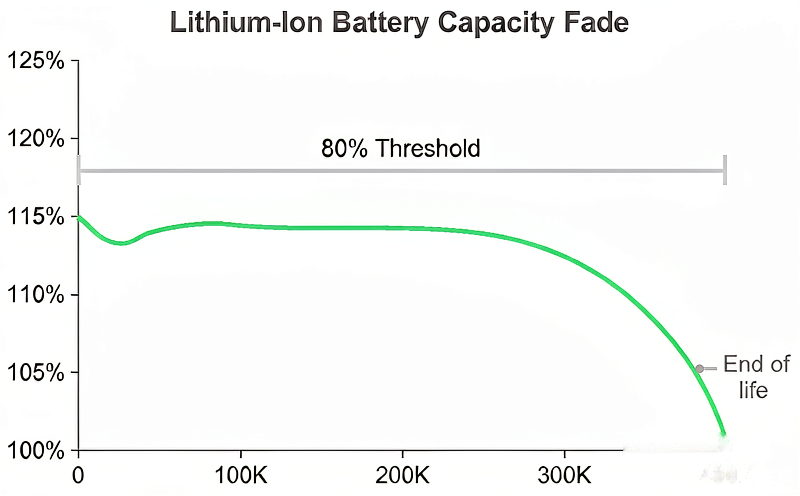
"Maximum battery life" is ambiguous for a good reason: it can mean the longest single flight, or the most cycles before replacement. The two pull in different directions, but they do not have to be opposites.
For the longest single flight, carry the highest-capacity pack the airframe can lift efficiently — 10,000-30,000mAh and beyond for professional long-endurance platforms. For the longest service life, avoid routinely draining the pack and avoid leaving it at 100%. Charging to about 80% instead of full on routine cycles can add substantially to total cycle count, at the cost of a slightly shorter flight.
The practical compromise most fleets settle on is a conservative flight profile with a hard reserve, packs charged to a working ceiling rather than the maximum, and spare packs ready so no single unit is pushed to its limit on every sortie.
• Trim unnecessary weight — lighter aircraft draw less current for the same mission
• Keep charged spares and swap early instead of pushing one pack to its floor
• Use eco or smooth-flight modes where the mission allows, trading agility for endurance
• Keep packs warm before cold-weather flights and avoid midday summer heat
• Do not leave a pack sitting at 100% — remove it from the charger once charged
• Store at 40% to 60% charge in a cool, dry place
• Retire packs that puff, self-discharge quickly or lose capacity — an aged pack is a safety risk, not a bargain
• Plan efficient flight paths and hold a steady speed rather than hovering unnecessarily
| Parameter | What to confirm |
|---|---|
| Voltage (cell count) | Match the ESC and motor rating. Common lithium polymer configurations are 1S at 3.7V, 2S at 7.4V, 3S at 11.1V, 4S at 14.8V and 6S at 22.2V |
| Capacity | Match to mission length, not to the largest pack that fits: 10,000mAh suits aerial photography, while racing platforms need small light packs |
| C-rating | Must cover peak current without overheating; camera drones and racers commonly sit between 30C and 100C |
| Size and weight | Must fit the battery bay and keep center of gravity inside limits |
| Connectors and wiring | Match the power distribution board; adapters add resistance and a failure point |
| Operating conditions | Cold-weather and high-altitude missions may need low-temperature cells or a heating strategy |
UFOPOWER builds custom packs to those parameters — voltage, capacity, C-rating, dimensions, connector type and low-temperature variants — with integrated BMS and 100% factory testing. OEM and ODM projects start from the aircraft's current profile rather than from a catalogue number.
Four developments are actively changing what UAV battery life means:
• Solid and semi-solid-state cells — higher energy density in the same weight with reduced fire risk; semi-solid-state packs are already available commercially, while fully solid-state designs are still maturing
• Hybrid fuel-electric systems — combining batteries with fuel-based generation for flights measured in hours rather than minutes
• Fast charging with thermal control — shorter turnaround between sorties without sacrificing cycle life
• Smarter BMS and health monitoring — per-cell balancing, state-of-health tracking and maintenance alerts that let a pack work closer to its limits safely
Further out, lithium-sulfur and lithium-air chemistries are being explored for very high energy density. None of them remove the engineering fundamentals: energy has to be carried, mass has to be lifted, and heat has to be managed.
UAV battery life is two numbers, and both are manageable. Flight time follows from capacity, current draw and efficiency, and it can be estimated before a pack is ordered. Cycle life follows from chemistry, depth of discharge, temperature and charging discipline, and it can be extended by treating the pack as an asset rather than a consumable.
Send UFOPOWER your aircraft's motor and current data, mission profile and temperature range, and we will size a pack that maximizes flight time without sacrificing the cycle count that decides your real cost per flight hour.
What is the difference between UAV flight time and UAV battery life?
How long do drone batteries last in cycles?
How do I calculate drone flight time from battery specs?
Does charging to 100% every time damage a UAV battery?
What C-rating does my drone need?
When should a UAV battery be retired?


 WhatsApp
 EN
 AR
 DE
 ES
 FR
 JP
 KO
 PT
 RU
 Home >