
 Sep 03, 2026
Electric motorcycles are among the most common forms of transport in South Africa, and motorcycle taxis are the lifeblood of daily commutes and goods delivery for hundreds of thousands of drivers. But unstable power grids, rising fuel costs and limited rider incomes make conventional home charging impractical. Out of these constraints, the battery swapping model has emerged as a natural solution. As a professional lithium battery manufacturer serving the African e-motorcycle market, UFOPOWER explains why battery swapping for electric motorcycles works in South Africa — and how to choose the right battery for it.
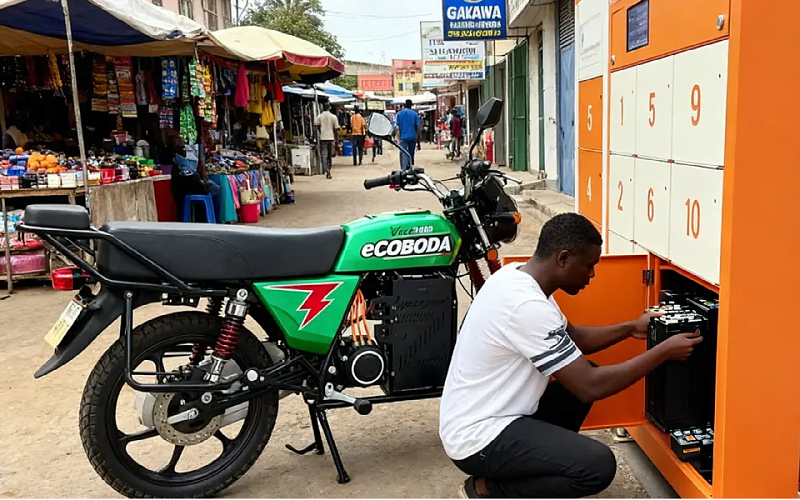
Three forces come together to make the swapping model a strong fit for South Africa:
A vast market base. Motorcycle taxis are the lifeblood of transport across Africa — with over 2 million motorcycle taxi drivers in Kenya and Uganda alone. The Southern African region presents a ready-made, massive target market for electric motorcycles and swapping services.
High fuel costs. Gasoline accounts for a significant share of operating expenses for fuel-powered motorcycles, and volatile oil prices keep eroding drivers' incomes. Electric motorcycles cut "fuel" costs by 30%–50%, which is highly attractive to income-earning riders.
Infrastructure bottlenecks. Many areas have unstable or non-existent power grids, making home charging difficult. Slow charging takes hours while drivers need their vehicles running continuously to earn — and the upfront cost of an electric motorcycle is already higher than a fuel-powered one. Swapping removes all three barriers at once.
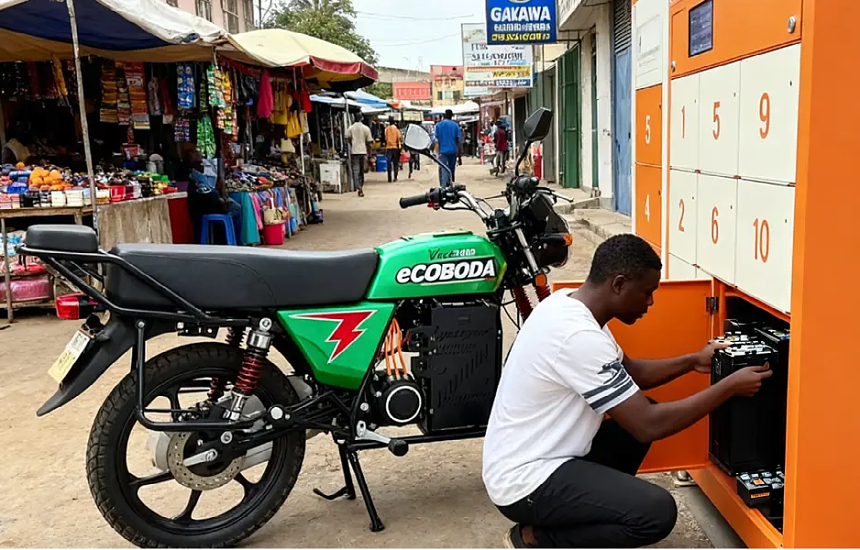
For riders who use their motorcycles as production tools, time is money. A battery swap takes only 1–3 minutes — comparable to refuelling a petrol motorcycle — while even fast charging typically needs 1–2 hours and slow charging 6–8 hours. The swap model eliminates long charging waits and enables nearly 24/7 operation, directly boosting daily mileage and income.
| Refuelling / recharging method | Time needed | Impact on rider income |
|---|---|---|
| Petrol refuelling | A few minutes | Baseline — minimal downtime |
| Battery swapping | 1–3 minutes | Comparable to refuelling — near-24/7 operation |
| Fast charging | 1–2 hours | Long downtime during peak earning hours |
| Slow charging | 6–8 hours | Overnight only — limits daily range |
The economics work for operators too. Centralized, professional maintenance keeps batteries charging under optimal conditions — constant temperature and humidity, precise charge/discharge curves — which significantly extends pack lifespan. Operators can schedule charging during off-peak night rates or use self-generated solar power, then serve customers during peak daytime hours. And batteries retired from swapping duty can still be repurposed for energy storage, unlocking a second revenue stream. A "battery-as-a-service" model also lowers the entry barrier for riders, who buy the vehicle body and lease the battery instead of paying the full upfront cost.
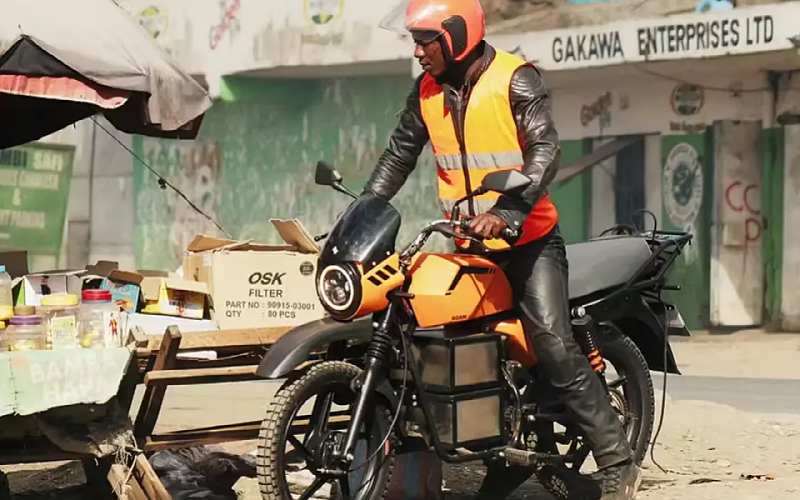
Three chemistries appear in today's African e-motorcycle market:
Lead-acid. Still used mainly in the personal, non-swapping segment. Its advantages are low manufacturing cost and low market price — but cycle life is only around 300 cycles, some types need periodic electrolyte maintenance, and charging is slow at roughly 0.1C–0.3C.
LiFePO4 (LFP). Currently the most preferred battery among battery swapping operators in Africa. It delivers over 3,000 charge cycles — one pack can serve multiple drivers for years, cutting per-use cost and forming the cornerstone of a profitable model. Its chemistry is exceptionally stable: high-temperature resistant, non-flammable, low explosion risk and virtually no thermal runaway. Free of precious metals like cobalt and nickel, it has low and stable raw-material costs, and its excellent high-temperature performance suits Africa's hot climate.
NCM (ternary lithium). Chosen by some operators for extended range. NCM offers higher energy density — longer range than LFP in the same volume or weight — plus lighter, more compact packs, strong rate capability for high instantaneous power, and reliable discharge down to around -20°C. Typical cycle life is 1,200–1,500 cycles, and raw-material costs are higher because the chemistry uses cobalt and nickel.
| Criteria | Lead-acid | LiFePO4 | NCM (ternary) |
|---|---|---|---|
| Typical cycle life | Around 300 cycles | Over 3,000 cycles | 1,200–1,500 cycles |
| Energy density | Low | Moderate — lower than NCM | High — more range per charge |
| High-temperature performance | — | Excellent — slower degradation in heat | — |
| Low-temperature performance | — | — | Reliable down to about -20°C |
| Raw-material cost | Low | Low and stable — no cobalt or nickel | Higher — uses cobalt and nickel |
In practice, lithium batteries — LiFePO4 or NCM — are the standard choice for electric motorcycle battery swapping in Africa. Their high energy density extends single-charge range, and when paired with an advanced battery management system they protect drivers and operators while cutting long-term costs through durability.
Lack of standardisation. Battery specifications, interfaces and swap-cabinet designs vary between operators, which can waste resources and limit user choice until governments or industry bodies step in.
Massive capital investment. Building a swap-station network and procuring large quantities of batteries and vehicles demands substantial upfront funding.
Grid and recycling gaps. Even with solar power, large-scale operations still depend on the grid, and battery recycling, second-life use and environmental disposal systems remain underdeveloped in the region.
User habits and trust. Riders must be educated and convinced to switch from long-established fuel-vehicle habits to a new technology.
Policy and regulatory risk. Tax policies, subsidies and industry regulation can significantly change the pace of industry development.
South Africa's climate, power conditions and usage patterns put unusual demands on a swapping battery: it must balance safety, lifespan, cost, weather resistance and maintainability. UFOPOWER's 72V 60Ah electric motorcycle battery for swapping networks is engineered for exactly this environment. Its intelligent thermal management combines liquid cooling and air cooling to keep cell temperatures stable even above 35°C — directly countering the effect of summer heat on battery performance and range. An IP66 protection rating lets the same pack serve both the dry inland climate and the high-humidity, salt-spray conditions of coastal regions.
The pack is built with high-grade A cells supporting 2,000 cycles at 100% depth of discharge — roughly 5–6 years of daily charge/discharge use — which significantly reduces long-term battery replacement costs for commercial operators and protects vehicle resale value for individual riders. A standardised interface makes it compatible with mainstream electric motorcycle models in the South African market, and its intelligent management system supports offline battery swapping, which is critical in remote areas with unstable communication networks. As a professional lithium battery manufacturer, UFOPOWER offers factory-direct OEM/ODM custom battery solutions, including rapid adaptation testing to ensure seamless compatibility across vehicle brands.
Looking ahead, the value of swapping extends beyond transport: each swap station acts as a micro-storage facility that can participate in power market regulation through smart-grid dispatch, strengthening grid stability and creating additional revenue for operators. For South Africa, the model is not just an answer to charging bottlenecks — it is a practical pathway toward cleaner, more efficient and more economical mobility.
Why is battery swapping better than charging for electric motorcycle taxis in South Africa?
How much can riders save with electric motorcycles?
Which battery type is best for battery swapping in South Africa?
How do swapping operators keep batteries safe?
What challenges does the battery swapping model face?
Do you supply swapping batteries designed for the South African market?


 WhatsApp
 国家1
国家1 Home >