
 Sep 03, 2026
Golf cart electrification is an irreversible trend — and the battery sits at the heart of the upgrade. When choosing a 48V golf cart battery, price alone is not enough: you also need to weigh battery type, range, charging time, protection level and lifetime cost. Today the mainstream choices are LiFePO4 and lead-acid, yet because of their performance differences LiFePO4 has become the only real choice for golf carts. As a professional lithium battery manufacturer, UFOPOWER explains what to look for before you buy.
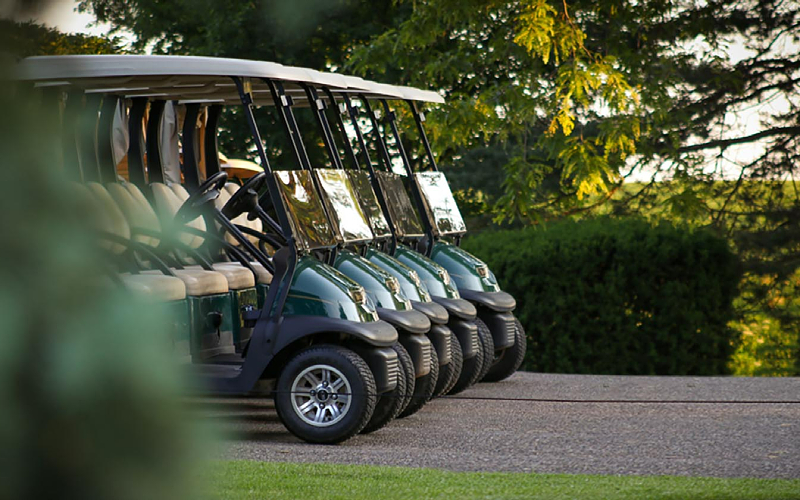
Before choosing a golf cart battery, you first need to understand the two main battery types. Lead-acid batteries have an obvious advantage in upfront price, but they fall far behind lithium iron phosphate in lifespan and energy density. LiFePO4 batteries, on the other hand, are superior in charging speed, temperature performance and cycle life — and over a full life cycle, a LiFePO4 battery costs only about one-quarter of what lead-acid costs. Although the single purchase price of LiFePO4 is higher, it is clearly the better choice for long-term use.
| Comparison | Lead-acid | LiFePO4 |
|---|---|---|
| Upfront price | Lower initial cost | Higher initial cost |
| Lifetime cost | Much higher over the full life cycle | About 1/4 of lead-acid over a full life cycle |
| Energy density | Lower — larger and heavier packs | Higher — more power in less space |
| Cycle life | Shorter — large gap vs lithium | Long — built for frequent cycling |
| Charging speed | Slow | Fast — 0 to 80% SOC in about 1 hour |
| Temperature performance | Weaker in heat and cold | Stable across a wider range |
| High-rate discharge | Around 0.5C — needs oversized capacity | Sustained 1C with 2C–3C peaks |
Golf carts face complex working conditions — carrying passengers, climbing slopes, and running in rain and sunshine — so their working current requirements are very high. Take a typical 48V 105Ah pack as an example: the continuous working current needs to reach 100A (1C), and the peak working current reaches 200–300A (2C–3C). Because lead-acid batteries can only discharge at around 0.5C, a much larger battery capacity would be needed to meet the same operating current — adding weight and reducing efficiency.
Fast charging is equally relevant to daily operation. With charging efficiency optimised at the design stage, a quality 48V LiFePO4 golf cart battery can be charged from 0 to 80% SOC in about one hour, which significantly shortens downtime between rounds and reduces the labour spent on manual recharging.
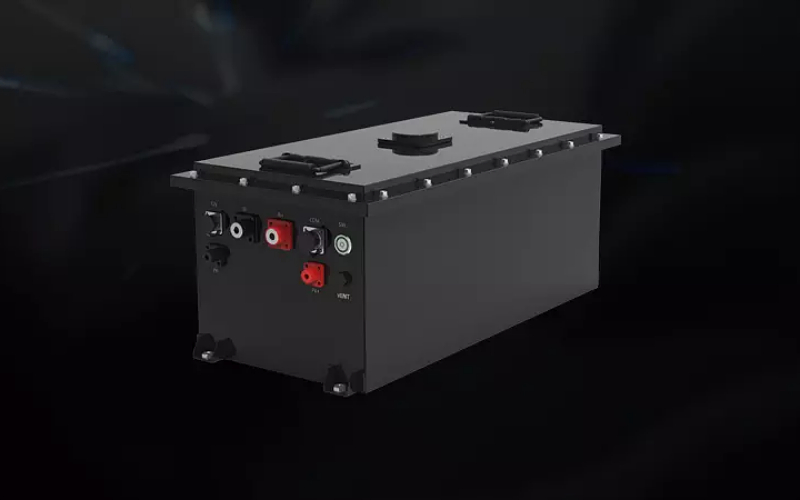
Most golf cart batteries on the market today use a "Smart BMS" solution, which is attractive mainly because of its lower cost and small initial investment. A Smart BMS integrates multiple charging and discharging MOS transistors, capacitors, resistors and other electronic components onto a single PCB. Functionally, it can only charge or discharge at one time and cannot control the two separately. More importantly, because a golf cart battery must discharge at high current, the MOS transistors run at high temperature under sustained load and are prone to failure through "thermal decay". And because there is no secondary protection mechanism, a single failure can lead to a serious safety accident.
That is why UFOPOWER's 48V golf cart battery uses a vehicle-spec BMS solution. Instead of managing the circuit through MOS transistors, it controls the circuit with industrial electrical components — relays, fuses, DCDC converters, shunts and pre-charging resistors — that are purpose-built for circuit control and have an extremely low failure rate. Even if a component ever needs to be replaced, the cost is far lower than replacing an entire Smart BMS board.
| Comparison | Smart BMS (common) | Vehicle-spec BMS (UFOPOWER) |
|---|---|---|
| Circuit management | MOS, capacitors and resistors integrated on one PCB | Relays, fuses, DCDC, shunts and pre-charging resistors |
| Charge / discharge control | Only one at a time; no separate control | Managed by industrial components designed for circuit control |
| High-current safety | MOS heats up under sustained current — prone to "thermal decay" failure | Extremely low failure rate under sustained high current |
| Failure protection | No secondary protection — serious safety risk if it fails | Fuses and relays provide redundant fail-safe protection |
| Replacement cost | High | Much lower than replacing a Smart BMS |
Cell quality is the single most important factor behind lithium battery performance. UFOPOWER sources only brand-new A-grade LiFePO4 cells from top-tier suppliers, and even so, every cell undergoes strict secondary screening so that the differential pressure between cells inside a pack is kept within ≤3mV. This cell matching is what delivers consistent power and a long service life under the stop-and-go, high-current load of a golf cart.
Quality management continues through the whole production chain. UFOPOWER's manufacturing system is certified to ISO9001 and IATF16949 quality management standards, and every pack is built on an in-house production line with strict quality control and 100% factory testing before shipment. As a professional lithium battery manufacturer, UFOPOWER also offers factory-direct OEM/ODM services — voltage, capacity, dimensions, connectors and BMS settings can all be customized to your golf cart model and usage pattern. Beyond golf carts, UFOPOWER serves other motive-power applications including forklifts, RVs, UAVs and electric tools, with the same engineering discipline.
Which is better for a 48V golf cart: LiFePO4 or lead-acid?
Can a 48V LiFePO4 golf cart battery handle hills and heavy loads?
How long does it take to charge a 48V golf cart lithium battery?
What is the difference between Smart BMS and vehicle-spec BMS?
How does UFOPOWER ensure the quality of its 48V golf cart batteries?
Do you offer customized 48V golf cart battery solutions?


 WhatsApp
 国家1
国家1 Home >