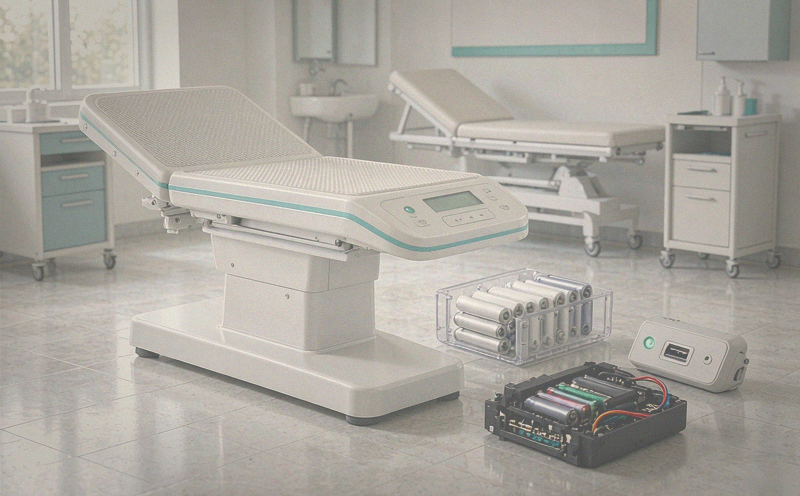
A medical examination scale looks like a low-power device, so battery choice is often left until the enclosure is nearly finished. That is the wrong order. The load cell, the analogue front end, the display and the wireless module all sit on the same rail, and the way that rail behaves as the battery drains decides whether the scale keeps its accuracy margin or starts drifting between calibrations. The choice between rechargeable and disposable batteries is therefore a metrology decision as much as a cost decision.
This article compares the two options on the factors that actually show up in service: voltage behaviour, daily energy use, five-year cost of ownership, hygiene and leakage risk, and the regulatory rules now shaping battery design in medical equipment. UFOPOWER is a professional lithium battery manufacturer supplying custom packs and standard rechargeable solutions for medical, fitness and portable diagnostic devices.
Why the Battery Affects the Measurement
Most medical scales use a strain-gauge load cell excited at a few volts and read by a high-resolution analogue-to-digital converter. The signal from a 150 kg load cell at half load is in the millivolt range, and the converter resolves a small fraction of that. Any change in excitation voltage changes the bridge output proportionally, so an unregulated rail that sags from 5.0 V to 4.6 V moves the reading with it unless the design compensates.
Two design choices decide whether that matters. A ratiometric measurement uses the excitation voltage as the converter reference, so a drop in excitation cancels out of the result. A regulated excitation rail holds the bridge voltage constant regardless of battery state. Either approach works; what does not work is an unregulated rail with a fixed reference and a low-battery warning that appears only when the reading has already drifted.
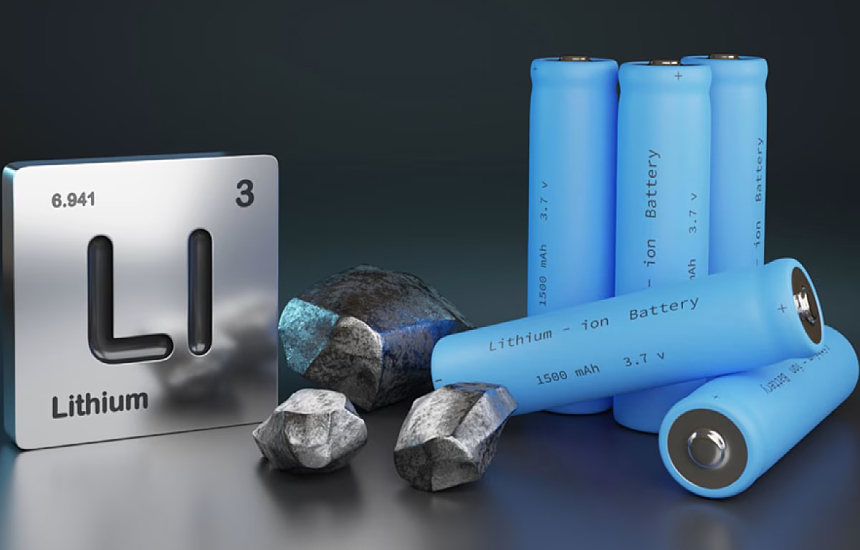
This is where disposable and rechargeable chemistries differ in practice. An alkaline cell holds a fairly flat 1.5 V for most of its life and then falls steeply at the end. A lithium rechargeable cell holds about 3.7 V nominal with a flat plateau between roughly 3.9 and 3.5 V, then drops quickly below that. Both need a low-battery annunciation, but the rechargeable pack gives the firmware a longer stable window in which the scale can keep weighing within tolerance.
The Two Options Side by Side
| Facteur | Disposable alkaline (AA or AAA) | Rechargeable (NiMH or lithium) |
|---|
| Upfront cost | Low, cells are a consumable | Higher at first, in the BOM or as a spare pack |
| Operating cost | Recurring purchase plus staff time for every swap | Electricity plus occasional pack replacement |
| Voltage behaviour | Flat, then a steep drop at end of life | Flat plateau for most of the charge, then a steep drop |
| Autodécharge | Very low, years on the shelf | Higher, especially standard NiMH; low-discharge types are better |
| Leakage risk | Real, and it destroys the PCB rather than the cell | Sealed pack with protection board, much lower risk |
| User handling | No charger, available anywhere, easy to replace | Needs a charger or USB-C port and a charging routine |
| Downtime risk | Scale stops when a cell dies without warning | Predictable if the gauge is honest, and chargeable between clinics |
| Best fit | Occasional home use, backup units, low-volume sites | Clinics, wards, fitness centres, daily home monitoring |
Runtime Comes From the Workload, Not the Datasheet
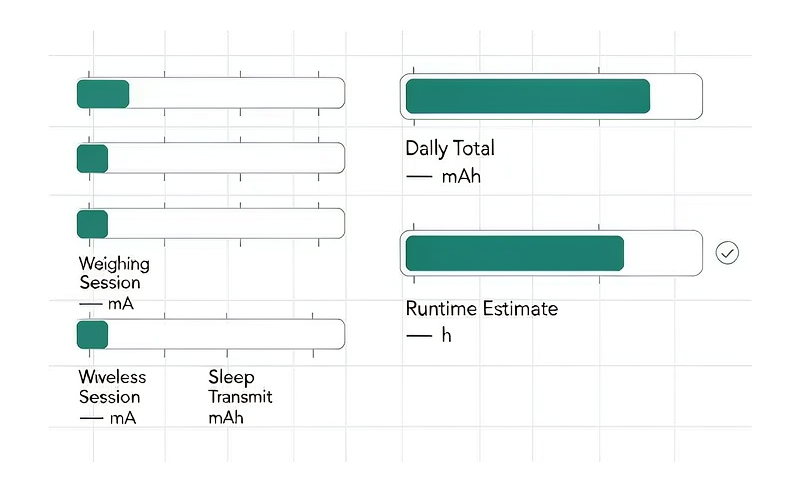
Battery life claims on scale datasheets are usually expressed in months without saying how many weighings that means. A clinic that weighs forty patients a day and a household that weighs once a week are not the same product requirement. The calculation below is a reference model: change the current figures to match your own hardware and the answer changes proportionally.
| Load | Reference current and duration | Charge per use |
|---|
| Weighing session, display and front end active | 35 mA for 20 s | 0.19 mAh |
| Display hold and auto-off delay | 12 mA for 60 s | 0.20 mAh |
| Wireless transmit, BLE or Wi-Fi | 60 mA for 3 s | 0.05 mAh |
| Sleep between patients | 0.02 mA continuous | 0.02 mAh per hour |
| Daily total at 40 weighings | Sum of the above | About 18 mAh per day |
At 18 mAh per day, a set of four AA alkaline cells with roughly 2,000 mAh of usable capacity at low drain lasts about 110 days, or a little under four months, in a busy clinic. The same calculation on a 1S lithium pack of 2,000 mAh gives a similar interval, but the pack is rechargeable, so the four-month event becomes a charging event rather than a purchase and a trip to the store. In a household weighing twice a week, either option lasts years, and the argument for rechargeable weakens.
Two corrections are worth making before you trust that number. First, boost converters and regulators waste energy: a 3.7 V pack feeding a 5 V excitation rail at 88 percent efficiency delivers roughly 12 percent less usable energy than the cell rating suggests. Second, cold storage and repeated disinfection raise quiescent current in some designs, so measure the sleep current on the actual board instead of trusting a firmware figure.
Five-Year Cost of Ownership
The TCO comparison is where disposable batteries lose in professional settings, but only if staff time is counted. The model below covers a clinic with thirty scales, an average of three cell changes per scale per year, four cells per change, and a loaded labour rate for the person doing the swap. It is an illustration with stated assumptions, not a quotation.
| Cost line (30 scales, 5 years) | Disposable alkaline | Integrated rechargeable |
|---|
| Cells or pack | 90 changes per year at about 1.20 per change, roughly 540 over five years | About 12 extra BOM per device, 360 once, plus one replacement pack per device in year four, about 240 |
| Charging hardware | Aucun | USB-C port and cable, about 2 per device, 60 once |
| Staff time | 90 changes at 8 minutes and 15 per hour, about 180 per year, 900 over five years | Plugging in between clinics, about 30 per year, 150 over five years |
| Leak damage | Two board replacements in five years, about 120 | Negligible with a sealed pack |
| Approximate five-year total | About 1,560 | About 810 |
The conclusion flips with volume. At three weighings a week, disposable cells cost almost nothing in labour and the rechargeable premium never pays back within the product life. At forty weighings a day across a fleet, the labour line alone dominates, and the rechargeable design wins before the environmental argument is even raised.
Matching the Choice to the Setting
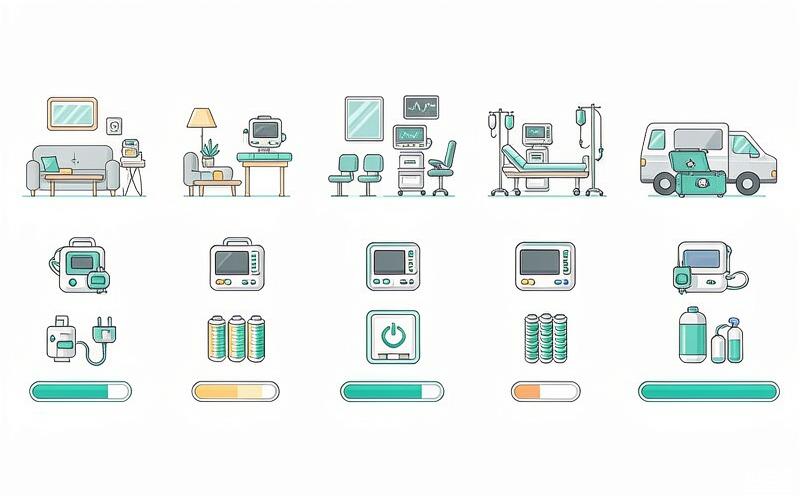
| Setting | Typical usage | Recommended power architecture |
|---|
| Occasional home weighing | One to three times a week | Disposable AA or AAA, low cost and no charging routine |
| Daily home monitoring | Once or twice a day | Rechargeable with USB-C, or a removable standard cell plus charger |
| Clinic and consulting room | Twenty to sixty weighings a day | Integrated lithium pack with a battery gauge and a charging dock |
| Hospital ward and mobile outreach | High volume, unreliable mains access | Two interchangeable packs, one on charge, plus a low-battery alarm |
| Telehealth and connected scale | Daily use with wireless upload | Rechargeable with a fuel gauge and a defined low-power mode for the radio |
Rules the Design Has to Satisfy
A medical scale sits at the intersection of two rule sets: electrical safety and metrology. Both have something to say about the battery.
Metrology. Non-automatic weighing instruments are assessed against EN 45501 and OIML R76, which define accuracy classes and the maximum permissible error at verification. The battery design has to guarantee that the instrument either stays inside that error band or annunciates a condition that stops it being used for a legal measurement. A low-battery symbol that appears after the reading has already moved is a non-conformity waiting to happen.
Electrical safety. If the scale is a medical device, IEC 60601-1 applies to the whole equipment, including the battery and its charging circuit. Charging from a USB-C supply while the patient is being weighed needs a clear rationale, and in most designs weighing during charge is either inhibited or isolated.
Battery safety and transport. A rechargeable lithium pack needs IEC 62133-2 evidence and a UN 38.3 test summary for shipping. NiMH packs fall under IEC 61951-2 for the cells. None of these replace the device-level assessment, they sit underneath it.
Replaceability. The EU Battery Regulation now pushes portable batteries in appliances toward being removable and replaceable by the end user, with derogations where safety or the operating environment requires a sealed design. A scale that needs a service technician to change a cell is a design decision that has to be justified, not a default.
Engineering Details That Decide Whether It Works
• Use a 1S or 2S lithium pack with a protection board rather than a bare cell, and specify the over-discharge cutoff above the point where the boost converter drops out
• Fit a fuel gauge or at least a coulomb-counting estimate, so the low-battery warning is based on remaining charge rather than on a voltage threshold that moves under load
• Keep charging current below the level that warms the enclosure, since a warm load cell drifts and the scale may be calibrated at a different temperature
• Seal the pack compartment against cleaning agents, and vent it if the pack can generate gas
• Key the connector so a replacement pack cannot be inserted with reversed polarity
• Document the charge profile, the pack part number and the replacement interval in the service manual, because that is what a biomedical department will follow
The Hidden Cost of Disposable Cells
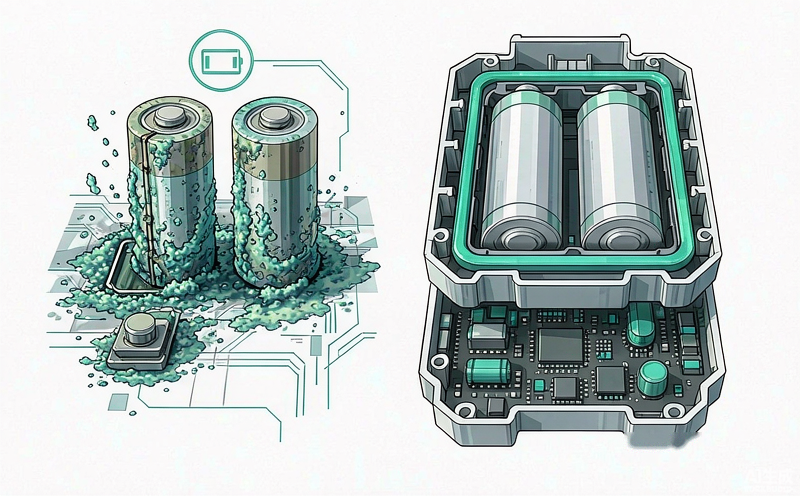
Alkaline leakage is the failure mode that does not appear in the TCO spreadsheet until it happens. A cell left in a scale that is stored for a season can vent potassium hydroxide onto the PCB, and the damage usually exceeds the value of the device. Mixed brands with different states of charge make it worse, because the weakest cell is driven into reverse by the stronger ones and vents first.
Disposable cells also behave badly in the cold. A scale kept in an unheated outreach vehicle will show a falling voltage that has little to do with remaining capacity, which is exactly the condition under which an unregulated design starts to drift. Rechargeable lithium packs lose capacity in the cold too, but the effect is reversible, and the pack recovers when it warms up.
There is an inventory dimension as well. A clinic that keeps disposable cells in stock has to manage expiry, storage and disposal, and staff have to notice when a device is running low. A rechargeable fleet replaces that with a charging routine, which is easier to audit and easier to put in a maintenance schedule.
What OEMs Should Put in the Specification
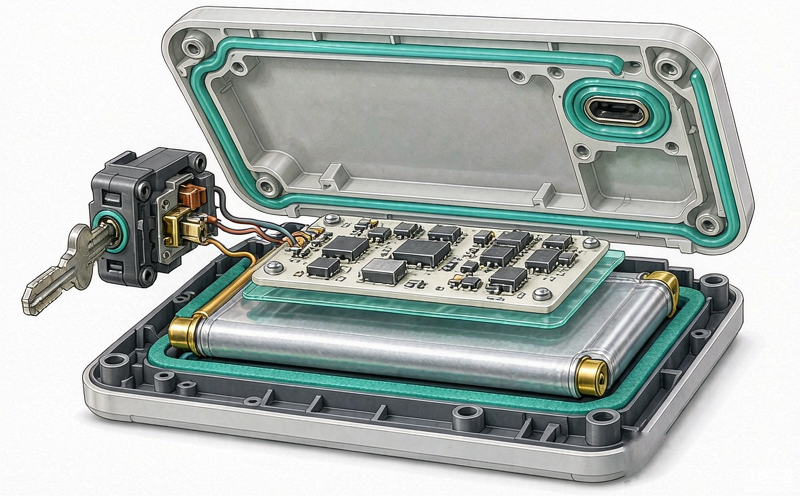
For a device brand, the battery decision changes the product, not just the BOM. A rechargeable pack allows a slimmer housing without a removable door, enables a sealed enclosure that survives disinfection, supports a USB-C charging port that customers already understand, and removes a recurring consumable from the after-sales story. A disposable design keeps the price point low and the user experience familiar, at the cost of a battery door, a gasket that wears, and a stream of returns when cells leak.
Whichever route you take, write these into the requirement document: nominal voltage and operating range at the load cell, peak current during wireless transmit, daily energy budget for the target workload, charge or replacement interval, low-battery annunciation threshold relative to the metrological error limit, cleaning agents the pack must survive, and the test evidence required for the chosen chemistry.
UFOPOWER builds both sides of that decision: standard rechargeable lithium packs for scales and health devices, and custom packs with integrated protection, fuel gauging and sealed connectors for OEM programmes. As a professional lithium battery manufacturer with in-house production and OEM/ODM support, the team can size a pack from a workload table rather than from a capacity guess, and supply IEC 62133-2 reports and UN 38.3 test summaries for the certification file.
Conclusion: Let the Workload Decide
There is no universal answer, but there is a clear rule. Below roughly one weighing a day, disposable cells are the rational choice: cheap, available, and easy for a user who does not want another charger. Above twenty weighings a day, the labour and leakage costs make rechargeable the better engineering decision, and the flat discharge curve gives the metrology design more room to breathe.
The mistake in both directions is the same: choosing a cell chemistry before the workload is known. Build the daily energy budget first, then the pack, then the charging routine, then the low-battery behaviour relative to the accuracy limit. Done in that order, the battery stops being a component at the end of the project and becomes part of the measurement chain.


 EN
 AR
 DE
 ES
 FR
 JP
 KO
 PT
 RU
 Accueil >
 Nov 19, 2026












 sur WhatsApp