

 Nov 11, 2026
"My leisure batteries are not big enough, they keep going flat." It is the most common complaint in camper and boat forums, and it is frequently wrong. The batteries are usually the size they were sold as. What disappeared is the difference between the number printed on the label and the number of amp-hours that actually reach a load when the bank is cold, old, half discharged and feeding an inverter.
That difference is not small. Take a 285 Ah lead-acid bank — three 95 Ah batteries at the 20-hour rate. Multiply it by the depth of discharge you are willing to use, then by the capacity the battery really delivers at your load, then by a factor for temperature and age, and you land near 96 Ah of usable energy, about 1.15 kWh. The label says 285. The system delivers a third of it. This article shows where the rest goes, and what to do about it before spending money on more batteries.
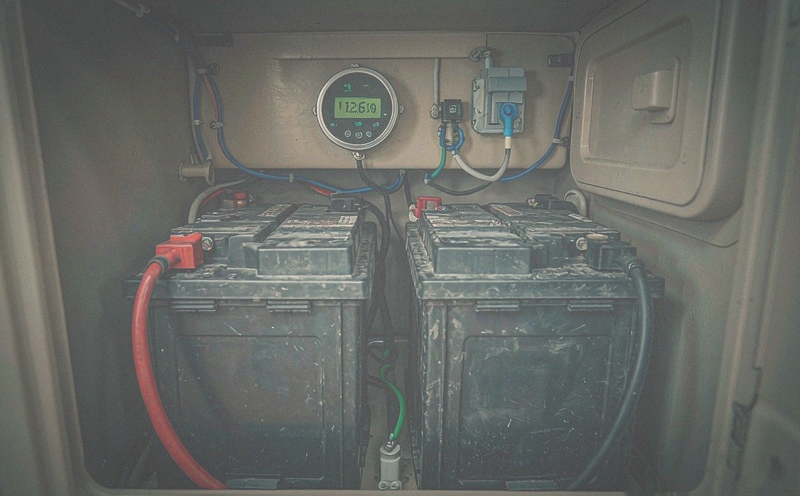
A lead-acid battery rated at 95 Ah (C20) is not promising 95 Ah under any conditions. It is promising that if you discharge it at 0.05C — 4.75 A — at 25 degrees Celsius, down to 10.8 V, it will deliver about 95 Ah. Change any of those three conditions and the number changes with them.
The same battery is often sold with a second rating, C5, which is the capacity at a five-hour discharge. A 95 Ah (C20) battery typically comes out around 85 Ah at C5, which is the manufacturer admitting in the datasheet that faster discharge delivers less energy. In an RV the load is rarely a steady 0.05C, so the C20 number is a ceiling, not an expectation.
Four independent factors reduce what a lead-acid bank can give you, and because they multiply, the loss compounds quickly. The table below runs the arithmetic on a 285 Ah bank at 12 V.
| ステップ | 因子 | Available capacity | Why |
|---|---|---|---|
| Nameplate at C20 | 1.00 | 285 Ah | 14.25 A discharge, 25 degrees C, to 10.8 V |
| Depth of discharge | 0.50 | 142.5 Ah | Below 50 percent, lead-acid life falls away fast |
| ほうでんそくど | 0.84 | 119.7 Ah | 0.1C instead of 0.05C, Peukert exponent 1.25 |
| Ageing allowance | 0.80 | 95.8 Ah | Planning margin so the system still works at end of life |
| Usable energy | — | 95.8 Ah = about 1.15 kWh | Against 3.42 kWh stored at C20 |
Temperature sits outside this table and makes it worse. Ratings assume 25 degrees Celsius; a bank at 5 degrees delivers measurably less, which is exactly when the heating and lights are running. That is why an owner who has never measured anything concludes the battery "failed" — the bank behaved as specified, under conditions nobody buys batteries for.
Peukert's equation describes how available capacity falls as discharge current rises. It needs one number, the exponent: about 1.25 for a typical lead-acid AGM bank, and about 1.05 for LiFePO4. A higher exponent means a steeper penalty for heavy loads.
| ほうでんそくど | Current | Run time | Amp-hours delivered | Share of nameplate |
|---|---|---|---|---|
| 0.05C | 14.3 A | 20.0 h | 285 Ah | 100 percent |
| 0.1C | 28.5 A | 8.4 h | 240 Ah | 84 percent |
| 0.2C | 57.0 A | 3.5 h | 202 Ah | 71 percent |
| 0.3C | 85.5 A | 2.1 h | 182 Ah | 64 percent |
| 0.5C | 142.5 A | 1.1 h | 160 Ah | 57 percent |
This is why an inverter changes everything. A 2 kW load at 12 V pulls roughly 170 A, which is 0.6C on a 285 Ah bank: the bank is now delivering barely half its nameplate capacity before depth of discharge is even considered. Add a kettle and a laptop charger and the numbers collapse further. The battery did not degrade overnight — it was being asked for power it never had at that rate.
Capacity ratings assume 25 degrees. Below that, both capacity and charge acceptance fall, while the voltage a charger must apply rises. A solar controller sitting in a warm cabinet can be reading a temperature ten degrees higher than the battery compartment, and if it charges to a voltage calculated at that temperature it will chronically undercharge a cold battery.
The fix is a temperature sensor on the battery itself, feeding the controller so that charge voltage is compensated. On lead-acid this is not a refinement, it is a requirement: a gel or AGM bank charged to a warm-weather voltage in winter never reaches full, and never reaching full is the single most reliable way to shorten its life.
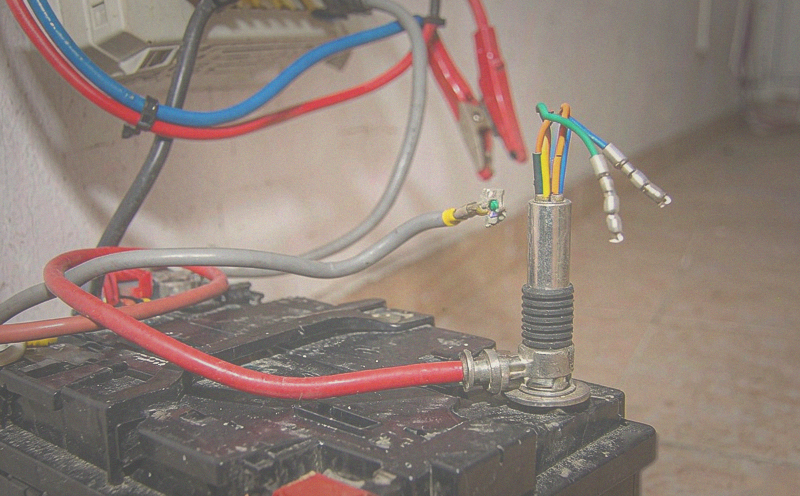
Lithium iron phosphate rewrites most of this table. Its Peukert exponent is close to 1.05, so a 200 Ah pack delivers close to 200 Ah whether the load is 20 A or 150 A. Its usable depth is 80 percent rather than 50, and its cycle life is measured in thousands rather than hundreds. The catch is price per kilowatt-hour and the need for a BMS, not the delivered energy.
| Option | 重さ | Usable energy at 25 degrees | じゅんかんじゅみょう | Relative cost |
|---|---|---|---|---|
| 12 V 90 Ah AGM | 27 kg | 540 Wh at 50 percent depth | About 600 cycles | 1.0 |
| 12.8 V 60 Ah LiFePO4 | 9.5 kg | 614 Wh at 80 percent depth | About 2,500 cycles | About 2.5 |
| 25.2 V 100 Ah NMC | 15.7 kg | 2,016 Wh at 80 percent depth | About 2,000 cycles | About 2.5 |
| 25.6 V 200 Ah LiFePO4 | 56 kg | 4,096 Wh at 80 percent depth | About 2,500 cycles | About 2.5 |
Read the first two rows together. A 9.5 kg lithium pack delivers more usable energy than a 27 kg AGM battery, and it will still be doing it after the AGM has been replaced four times. That is the real argument for lithium in a vehicle where every kilogram sits on an axle and every cubic decimetre competes with a bicycle.
Three changes cost far less than a new bank and often recover the capacity that was "missing". The first is lighting: replacing incandescent and halogen fittings with LED cuts that circuit to roughly a tenth of its draw. The second is the solar controller: a PWM unit throws away the voltage difference between the panel and the battery, while an MPPT unit converts it into charge current, which matters most in cold weather and low light. The third is charging voltage at the battery, which is what a temperature sensor fixes.
• Measure daily amp-hours before changing anything, so the improvement is provable.
• Convert lighting to LED and re-measure; the drop is usually the largest single win.
• Replace PWM with MPPT if the panel is over about 100 W, and add battery temperature sensing.
• Confirm the charger can deliver at least 10 percent of capacity in amps — a 285 Ah bank wants about 29 A minimum.
• Check alternator and cabling before assuming the battery is the limit.
Doubling capacity doubles the time needed to refill it. A 285 Ah AGM bank wants roughly 29 A just to hold its own, and a proper recharge from 50 percent takes five to eight hours of absorption — not two hours of idling. Add capacity without adding charge current and the bank spends its life between 60 and 80 percent, which is the condition that turns a five-year battery into a two-year battery.
This is the hidden cost of an in-place upgrade. A larger bank may need a larger charger, thicker cable, a bigger alternator and a second solar controller, and the space for all of it rarely exists in a vehicle that was designed around a 78 Ah battery under the passenger seat.
Electric bikes are the load that quietly breaks these budgets. A 500 Wh bike battery sounds modest until the losses are counted: the charger converts AC to DC at about 85 percent efficiency, the inverter converts DC to AC at about 90 percent, and the bank pays for both. That is roughly 654 Wh drawn from the battery to put 500 Wh into a bike pack — 54 Ah at 12 V for a single charge.
| Load | Delivered to the device | Drawn from the 12 V bank | Share of 96 Ah usable |
|---|---|---|---|
| One e-bike battery | 500 Wh | About 654 Wh, 54 Ah | 56 percent |
| Two e-bike batteries | 1,000 Wh | About 1,308 Wh, 109 Ah | 114 percent |
| Inverter idle, 8 hours | — | About 115 Wh, 9.6 Ah | 10 percent |
Two bike charges consume more than the entire usable capacity of the 285 Ah bank, before a single light or the fridge has run. This is the point at which owners conclude that lead-acid cannot do the job — and for this duty they are right. It is not a defect in the batteries; it is a duty cycle the chemistry was never specified for.
When more capacity is genuinely needed, series connection of large monobloc batteries is generally preferable to paralleling small ones. Parallel strings share current imperfectly: a weak or ageing battery drags the healthy ones, and a bad connection in one string leaves the others carrying the load. Two 12 V batteries in series for 24 V, or four for 48 V, keeps one current path and one BMS view.
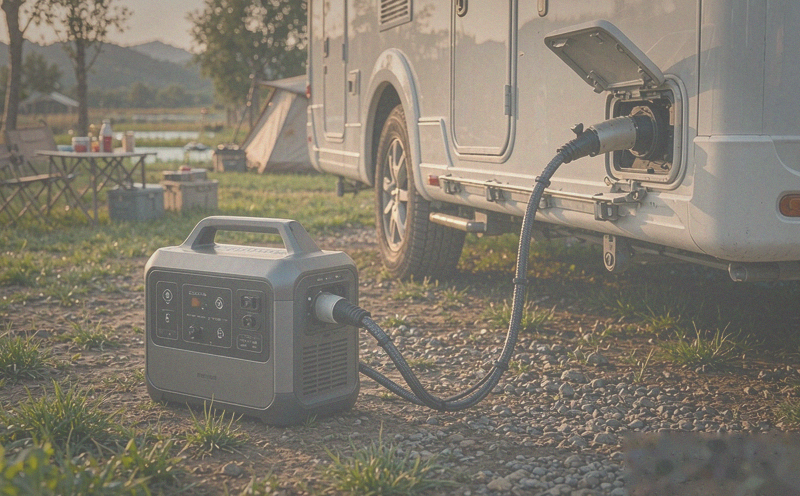
For a vehicle that cannot be rebuilt, the practical alternative is a separate pack that parallels the existing system only at the AC side. A portable power station connected into the shore inlet — downstream of the hook-up socket and before the consumer unit — leaves the original wiring untouched, adds AC and DC capacity where it is needed, and can be unplugged and used elsewhere. It is not elegant engineering, but it is reversible, and reversibility is worth a lot in a vehicle you did not design.
Whether the answer is a rebuilt bank or an additional pack, the specification is the same five lines: usable kilowatt-hours at the loads you actually run, continuous and peak current, charge voltage window, low-temperature behaviour and how the BMS reports itself. Nameplate amp-hours do not appear on that list, because they are the least informative number on the datasheet.

UFOPOWER is a professional lithium battery manufacturer producing 12 V, 24 V and 48 V LiFePO4 packs for RV, marine and off-grid applications. The sizing conversation starts with the load schedule and the worst-case discharge rate, because a pack that is right for a 20 A average load can be wrong for a 170 A inverter surge even if the kilowatt-hours match.
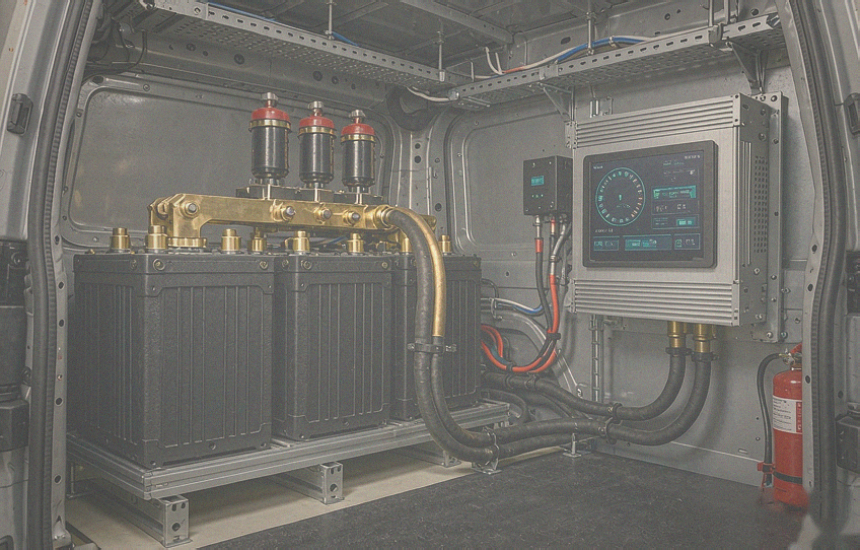
Packs are built with welded busbars, in-house BMS design, temperature-sensed charge protection and CAN or RS485 reporting, and each one leaves the line with a capacity and high-current discharge test recorded against its serial number. OEM and ODM customization covers enclosure dimensions, terminal layout and protocol details — which is what decides whether a new pack drops into an existing compartment or forces a rebuild.

Send UFOPOWER the loads, the voltage you are running and the space available, and the reply comes back as a pack that states usable energy at your discharge rate rather than a number measured at 0.05C in a laboratory.
Why does my 285 Ah battery bank only deliver about 96 Ah?
What is Peukert's law in plain terms?
Does a bigger battery bank take longer to charge?
Is it better to add another battery or a separate portable pack?
Series or parallel for more capacity?
Do lithium batteries have the same capacity problem?


 EN
 AR
 DE
 ES
 FR
 JP
 KO
 PT
 RU
 家(いえ) >


 WhatsApp