
 Oct 26, 2026
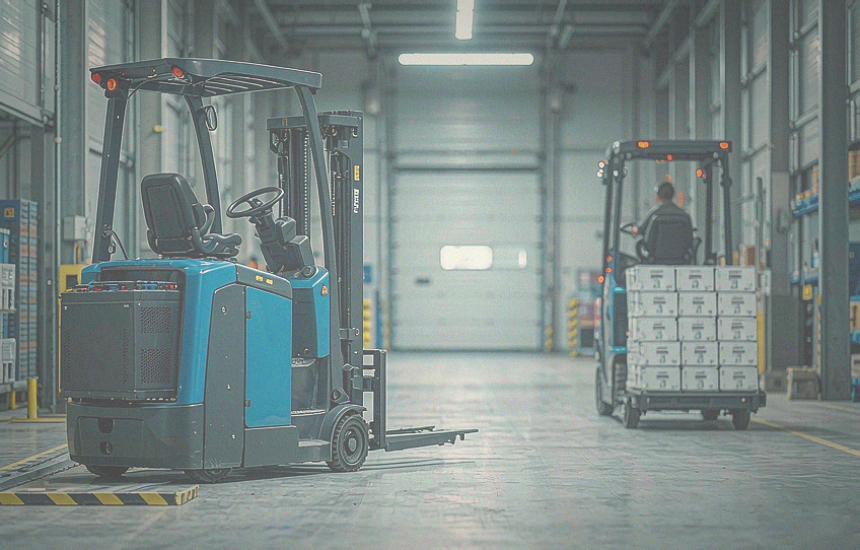
Roughly seventy percent of new forklifts sold in the United States are battery powered, and about eighty percent of the electric fleet on the floor today still runs on lead-acid. That mix is shifting quickly, and the questions we hear from fleet managers have not changed in years: which forklift battery should I buy, which charging method is right, and how do I make a pack last as long as possible.
All three answers come down to how a battery is counted. Pack life is measured in charging cycles, not hours and not years, which means the way you charge decides the way you spend. This primer covers the three battery types in use today, the cycle arithmetic behind them and the charging methods that either protect or consume that cycle budget. UFOPOWER is a professional lithium battery manufacturer supplying factory-direct packs for 24V, 48V and 80V trucks, so we will be explicit about where lead-acid still wins and where it does not.
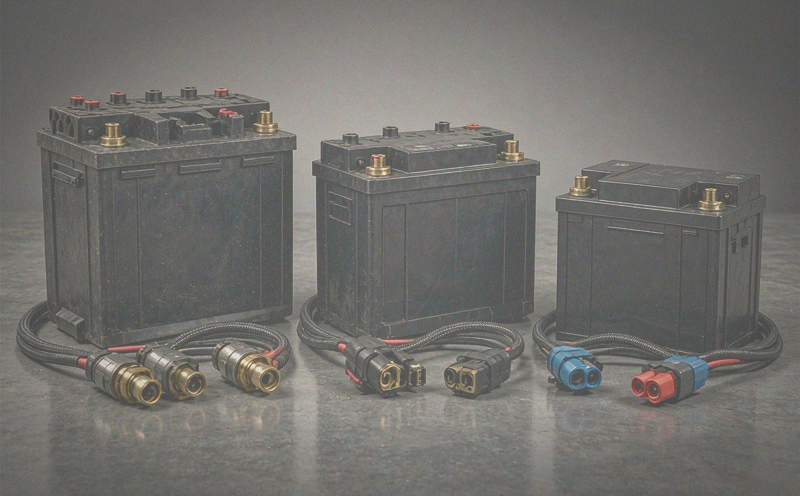
There is no fourth option hiding in the catalogue. Every electric truck you buy today is designed around one of these three chemistries, and each one has a clear best-fit operating profile.
| Faktor | Flooded Lead-Acid | TPPL (Thin Plate Pure Lead) | Lithium-Ion (LiFePO4) |
|---|---|---|---|
| Upfront cost | Lowest per unit | Between the two | Highest per unit |
| Typische Lebensdauer | About 1,500 cycles on average | Longer than flooded, shorter than lithium | Up to about 3,000 cycles |
| Routine maintenance | Watering, cleaning, equalization | No regular watering routine | Effectively none, sealed pack |
| Opportunity charging | Not designed for it, shortens life | Supported | Supported and recommended |
| Multi-shift practicality | Needs spare packs plus changing equipment | Workable with opportunity charging | One pack per truck, five to seven years typical |
| Cold storage | Capacity drops with temperature | Well suited to cold rooms | Discharge is fine, charging below freezing needs heating or cutoff |
| Best fit | Single shift, light duty, tight budget | Cold stores and moderate multi-shift use | Multi-shift, high utilisation, uptime-driven sites |
Battery life is limited by charging cycles, not by hours on the clock or by years on the shelf. That single sentence explains most of the strange economics in this industry.
On a flooded lead-acid pack, a cycle is a cycle. Whether you plug in at 35 percent state of charge or at 75 percent, the pack gives up one of its roughly 1,500 lives. This is why the cheapest habit is also the most expensive one: plugging in after every short task burns through the cycle budget without moving any extra pallets. The counter-habit is to delay charging until the pack is down to roughly 30 to 35 percent remaining, and never to let it fall below 20 percent, where the plates take real damage.
Lithium changes the accounting. A LiFePO4 pack rated at up to about 3,000 cycles does not count a partial charge as a full cycle, which is why a multi-shift site can run the same pack for five to seven years. A truck that takes on 80 percent of its capacity over a lunch break and a shift change has not spent a full cycle, and it starts the next shift with real energy in reserve.
| Charging Behaviour | Lead-Acid Consequence | Lithium Consequence |
|---|---|---|
| Plugging in after every short task | Spends a full cycle each time, capacity falls early | Counts as partial charge, cycle budget barely touched |
| Waiting until 30 to 35 percent remains | Correct habit, protects the cycle budget | Acceptable, no penalty either way |
| Running below 20 percent | Plate damage, permanent capacity loss | BMS protection trips, truck stops; repeated deep events age the pack |
| Top-up over a lunch break | Shortens life, needs heat and electrolyte monitoring to even attempt | Designed use case, up to 80 percent in a break |
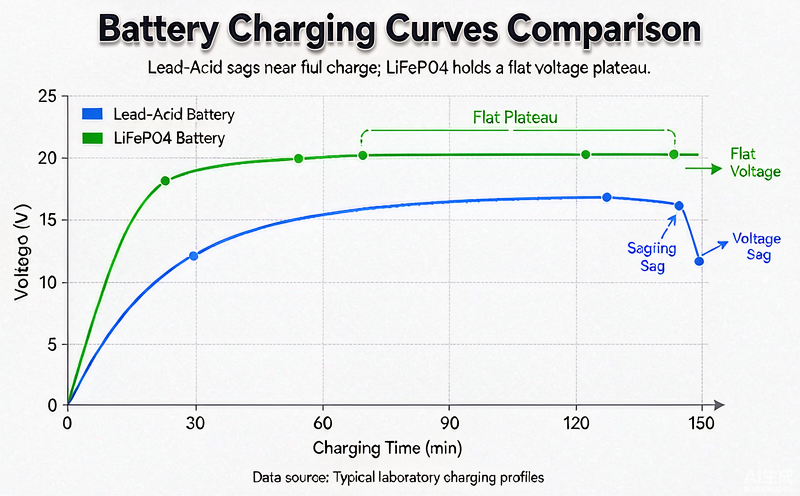
Conventional, opportunity and fast charging are not three flavours of the same thing. They are three different demands on the pack, and only some chemistries can absorb them without paying in lifespan.
| Method | How It Works | Suitability by Chemistry |
|---|---|---|
| Conventional charging | Full charge plus cool-down, typically eight hours plus a cooling period, in a dedicated charging area | The design case for flooded lead-acid. Also fine for lithium, but it uses the pack's capability poorly |
| Opportunity charging | Short partial charges during breaks, shift changes and loading waits, on distributed chargers | Designed behaviour for lithium and supported by TPPL. Not what flooded lead-acid was built for |
| Schnelles Laden | High-rate charging that returns most of the capacity in a short window, requiring charger and pack to be matched | Practical for lithium packs built for the rate. On lead-acid it trades lifespan for convenience |
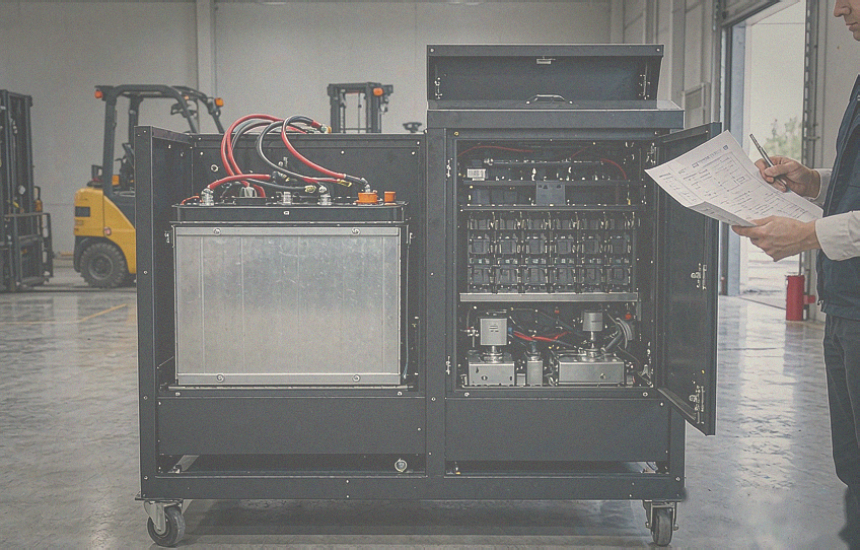
Lead-acid can be pushed into opportunity or fast profiles, but only with monitoring hardware that watches heat, electrolyte level and amperage throughput, and even then the pack pays for it in service life. Some sites simply buy extra batteries to cover the difference, which then requires a battery changing system, a bay, a hoist and the labour to run it. That infrastructure cost is real money and it rarely appears in the first quotation.
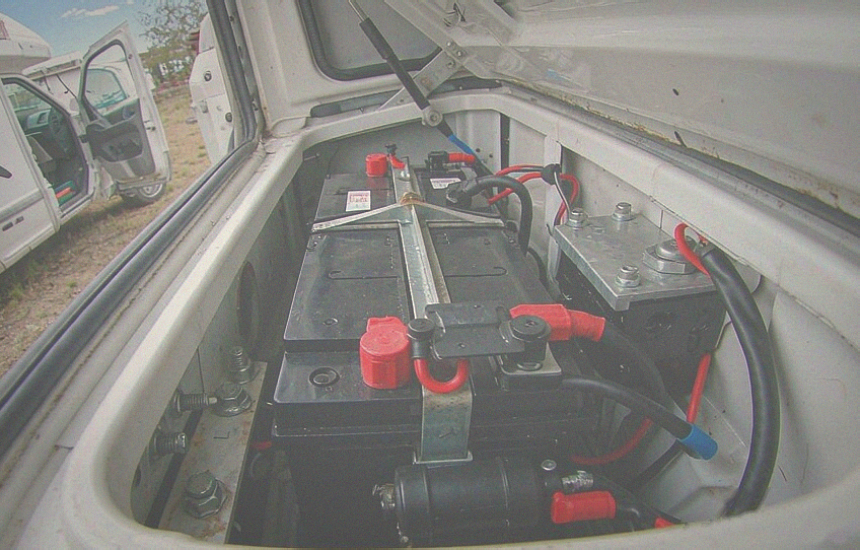
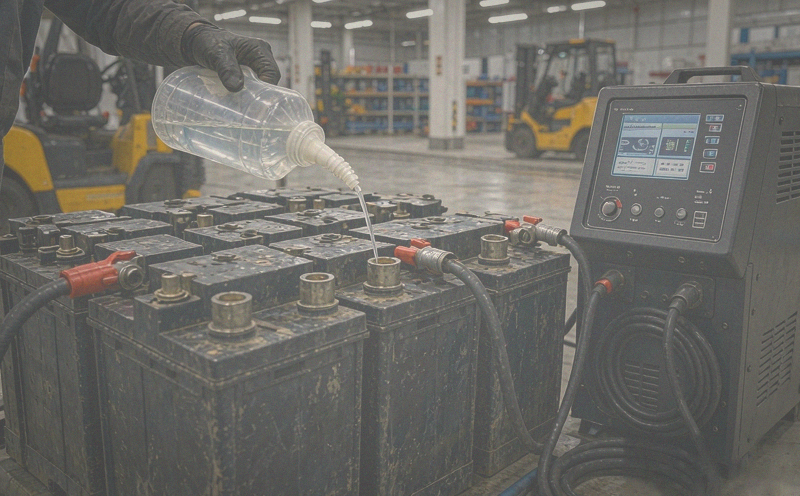
Flooded lead-acid uses a sulfuric acid electrolyte that has to stay at the correct dilution. If the electrolyte drifts out of balance, or the plates dry out, voltage stops being consistent. Water also carries heat away from the pack, and a pack that cannot shed heat will overheat and fail.
Check levels about every five cycles, and top up with pure or distilled water rather than tap water once the plates become visible in several cells. Water only after the pack has been charged, and expect older packs to need attention more often than new ones.
Equalization is the other scheduled task. It is an extended charge that breaks down sulfate build-up on the plates and brings individual cells back to a common output, because sulfated plates lose capacity and mismatched cells drag down the whole pack voltage. In practice, a pack that normally charges in eight hours might equalize over eleven hours, and many sites run the cycle over a weekend. Age, type, size and duty cycle all change how often a given pack needs it, so the charger settings and the manufacturer guidance win over any generic schedule.
Industry forecasts for the end of the decade point in one direction. By 2029, more than 62 percent of new electric forklifts sold in the United States are expected to ship with lithium-ion packs, about 33 percent with lead-acid and roughly 4 percent with hydrogen fuel cells. The driver is not fashion, it is the cycle arithmetic: a chemistry that tolerates partial charging removes the need for spare packs, battery rooms and changing equipment, and multi-shift operations feel that saving immediately.
• One shift, light duty, existing charging room: flooded lead-acid still makes financial sense, provided the watering and equalization routine actually happens.
• Cold store with moderate utilisation: TPPL is a reasonable middle path, with no regular watering and good behaviour at low temperature.
• Two or three shifts, uptime-critical: lithium, sized in kWh from measured consumption rather than copied from the old Ah rating.
• Mixed fleet: convert the high-utilisation trucks first and leave the light-duty units on lead-acid until their packs reach end of life.
• Any chemistry: buy the charger with the pack, not after it, and match the charge profile to the chemistry instead of assuming a charger is a charger.
UFOPOWER is a professional lithium battery manufacturer building forklift packs factory-direct on in-house production lines rather than reselling a catalogue part. For fleets moving from lead-acid to lithium, that means the pack is specified around the truck, the duty cycle and the charging layout.
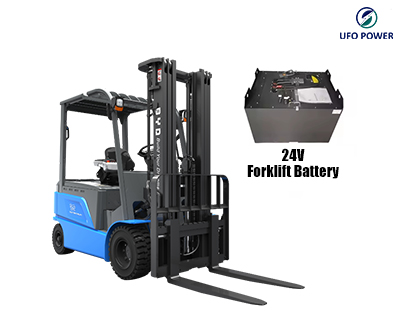
• 24V, 48V and 80V platforms with capacity sized from truck-hour energy data, not from the old nameplate.
• BMS with real protection: cell over-voltage and under-voltage, over-current, temperature monitoring, low-temperature charge cutoff and cell balancing.
• CAN or RS485 communication so the truck shows state of charge and derates gradually instead of stopping mid-aisle.
• Custom enclosures and connectors for retrofit projects, plus OEM and ODM builds with sample validation before volume.
• 100 percent factory testing of capacity, internal resistance, charge and discharge behaviour and enclosure sealing, with batch traceability for warranty support.
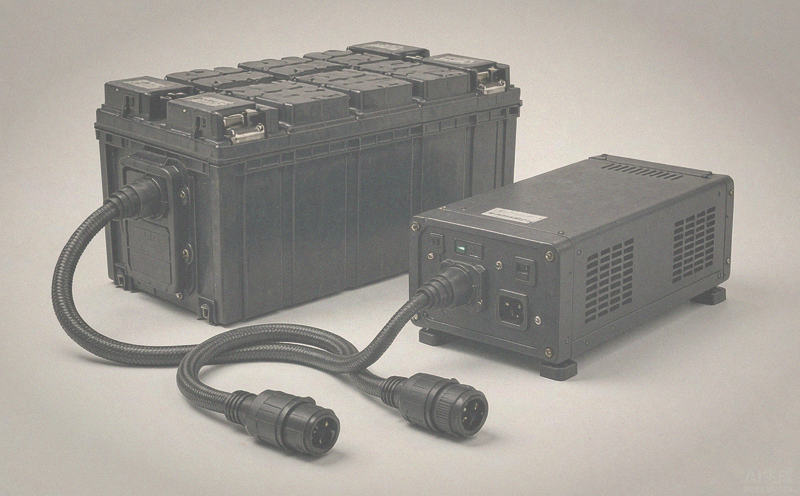
If you are deciding between chemistries for a fleet, send the truck models, shift pattern and a week of charging logs. UFOPOWER will convert that into a pack recommendation in kWh, a charging method that matches the site and a cycle-cost comparison over five years.
What is the difference between lead-acid, TPPL and lithium-ion forklift batteries?
How many cycles does a forklift battery last?
Should I charge my forklift battery after every use?
What is equalization charging and when is it needed?
Can I use opportunity charging with lead-acid batteries?
Are lithium forklift batteries usable in cold storage?


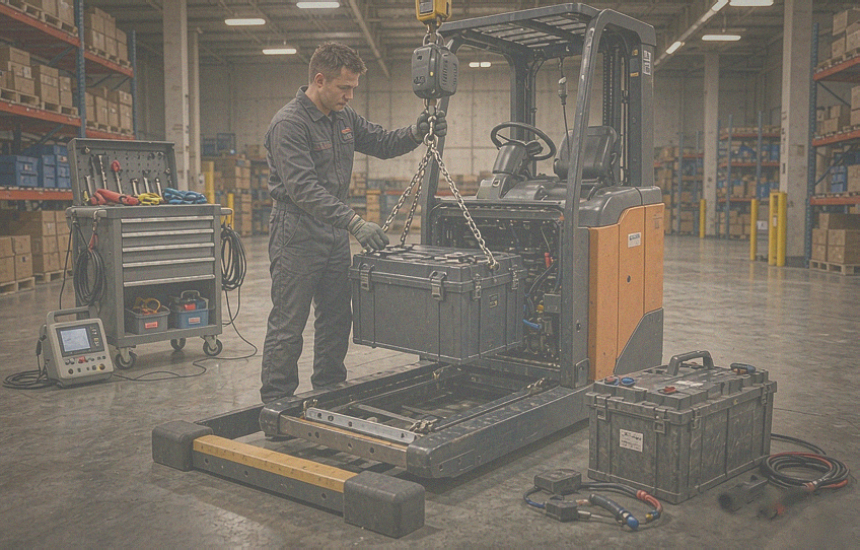
Forklift Lithium Battery Upgrade: A Step-by-Step Retrofit Checklist for Multi-Shift Fleets
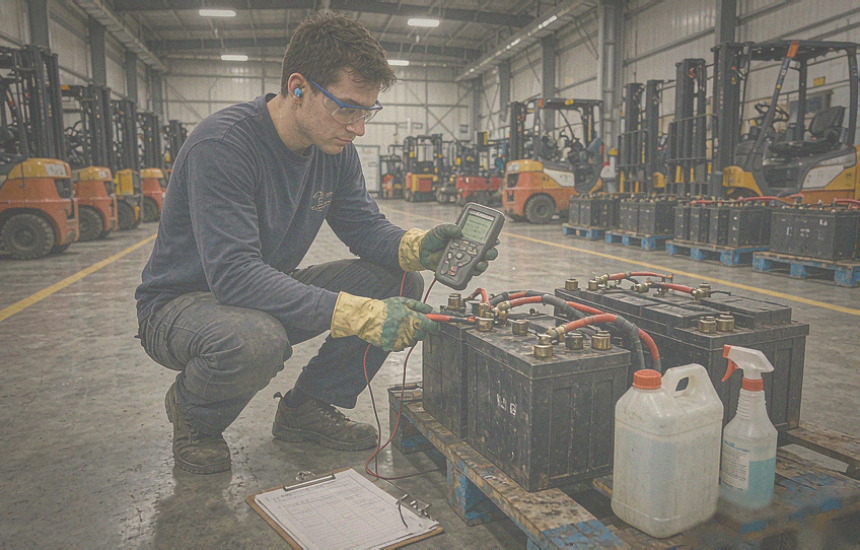
Forklift Battery Maintenance: A Practical Schedule for Lead-Acid and Lithium Packs


 WhatsApp
 EN
 AR
 DE
 ES
 FR
 JP
 KO
 PT
 RU
 Startseite >