A motorhome that has to run air conditioning, a residential fridge, hydraulic slide-outs, leveling jacks and a diesel heater does not have one electrical problem. It has three, and they pull in opposite directions. Cranking the engine wants a few hundred amps for two seconds and does not care about depth of discharge. Living off grid for a week wants 30 kWh of usable storage that can be cycled every day for a decade. Running a hydraulic slide-out wants 200 to 300 amps for ninety seconds, several times in an afternoon, at a voltage that keeps the pump motor at full speed.
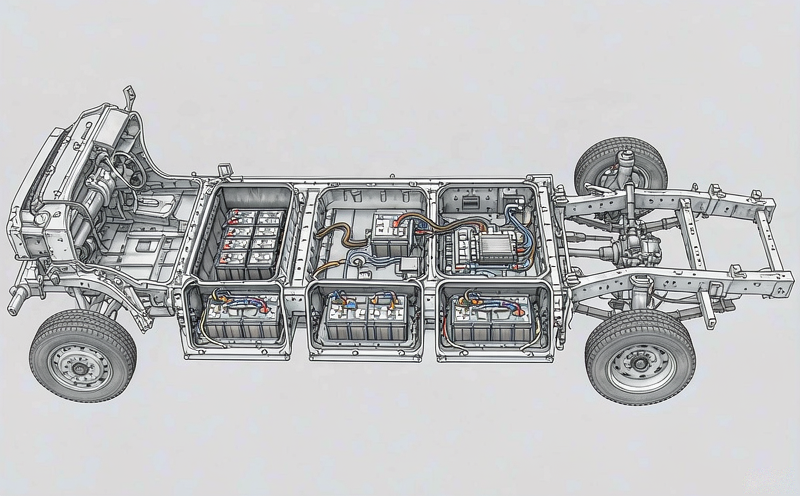
The builds that work are the ones that stop pretending one bank can do all three. They run a three battery system architecture: a chassis battery that only starts the engine, a high-voltage house bank that carries domestic loads, and an auxiliary pack that exists purely for the mechanical hardware. This article breaks down how those three systems are sized, how they are coupled, and where the design fails. UFOPOWER is a professional lithium battery manufacturer supplying custom 12 V and 48 V LiFePO4 packs for RV, marine and off-grid builds, so the numbers below are written from the pack side of the job.
Three Battery Systems, Three Different Jobs
The split is not a fashion decision, it follows the duty cycle of each load group. A starting battery is optimised for burst current and kept at full charge; a house bank is optimised for energy and cycle life; the auxiliary pack sits between the two, delivering short high-current events without ever being deeply discharged. Chemistry follows duty: the chassis battery is usually AGM or flooded lead-acid, because it lives at 100 percent state of charge and only ever delivers short bursts, while both the house and auxiliary banks are normally LiFePO4.
| System | Tensão | Reference capacity | Chemistry | Duty profile | Charged by |
|---|
| Chassis / starting | 12 V | 80 to 120 Ah, about 1.2 kWh | AGM or flooded | 500 to 900 A cranking bursts, then float | Engine alternator |
| House bank | 48 V nominal, 51.2 V in service | 600 Ah, over 30 kWh | O LiFePO4 | 5 to 8 kWh per day, multi-day autonomy | Solar MPPT, shore charger, DC-DC from alternator |
| Auxiliary / mechanical | 12 V | 320 Ah, about 4 kWh | O LiFePO4 | 2 to 3 kW hydraulic pump, 30 to 90 s events | DC-DC converter from the house bank |
Read the third row twice, because it is the system most builds get wrong. Slides and levelers are not a continuous load and they are not an energy problem: ninety seconds of a 3 kW pump is 0.075 kWh. What they are is a current problem. A bank sized only for daily energy will simply not deliver that surge at a usable voltage, and the pump will run slow and hot for the rest of its life.
Why the House Bank Moves to 48 V
Once the inverter passes 3 kW, 12 V stops being a sensible house voltage. The arithmetic is unforgiving. A 5 kW load draws 391 A from a 12.8 V bank and only 98 A from a 51.2 V bank. Cable loss rises with the square of current, so for the same cable the 48 V side dissipates roughly one sixteenth of the heat that the 12 V side does at identical power. That single relationship is the whole argument for the higher voltage: it turns a cable-sizing problem into a cable-routing problem, and it lets the battery live further from the inverter without paying for it in heat.
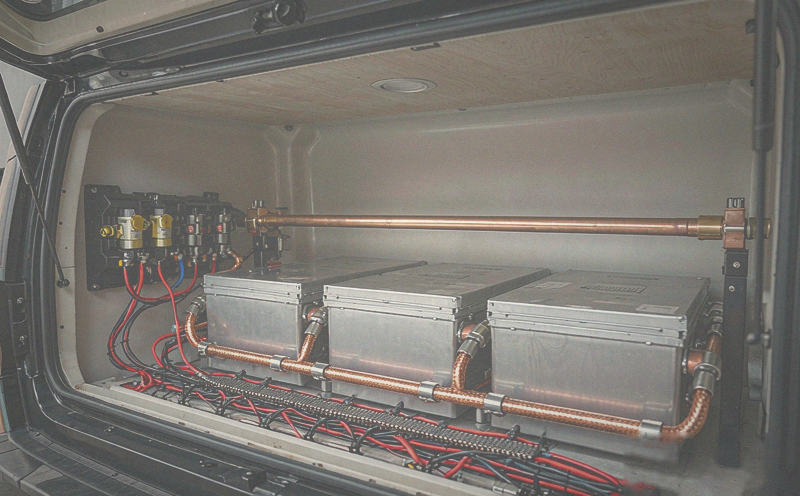
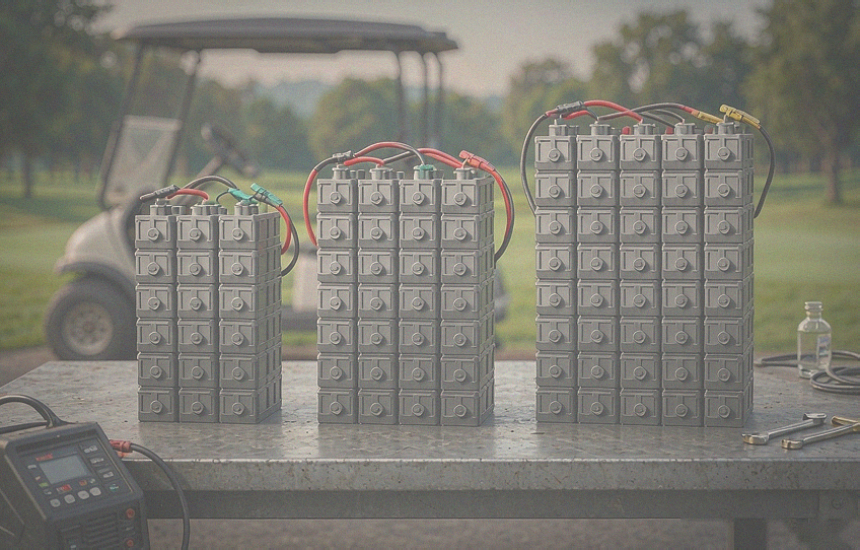
Practically, a 48 V RV bank is 16 LiFePO4 cells in series: 51.2 V nominal and 58.4 V at full charge, which is why installers speak of a 48 V system that measures 51 V on the meter. Six 51.2 V 100 Ah batteries in parallel give 30.7 kWh, which is the reference build this article keeps coming back to.
| Inverter load | Current at 12.8 V | Current at 51.2 V | Relative cable loss, same cable |
|---|
| 1 kW | 78 A | 20 A | 1 |
| 3 kW | 234 A | 59 A | 1/16 at 48 V |
| 5 kW | 391 A | 98 A | 1/16 at 48 V |
| 8 kW | 625 A | 156 A | 1/16 at 48 V |
Coupling the Systems: DC-DC, Not Direct Parallel
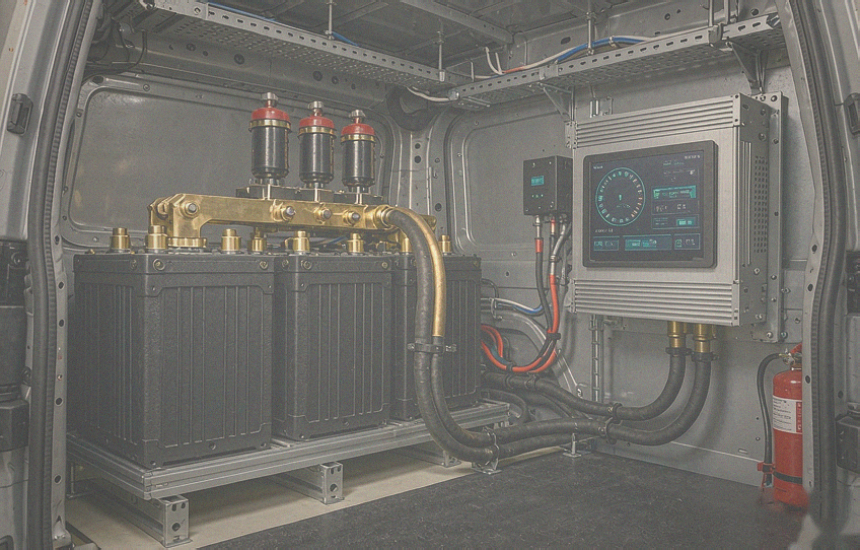
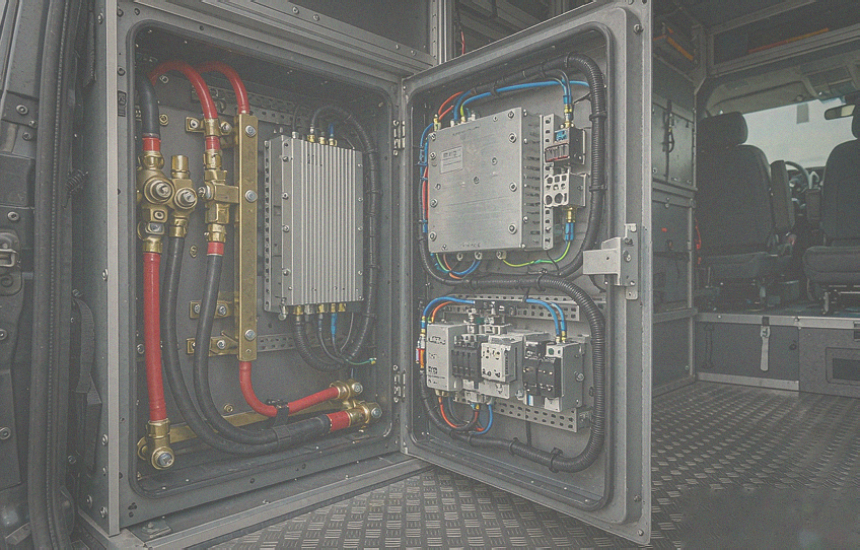
Three banks at two voltages cannot be tied to one bus. Something has to sit between them that converts voltage and enforces a charge profile, and that device is a DC-DC converter or charger. In the layout described here the chassis alternator feeds a DC-DC charger that lifts 12 V to the 48 V house bus, and a second converter steps 51.2 V back down to 12 V for the auxiliary pack. Isolation matters as much as voltage: with an isolated converter the negative rails of the two systems stay separate, which removes ground-loop noise from the monitoring electronics and prevents a single chassis fault from taking out both banks.
| Coupling method | Como funciona | Best for | Watch out for |
|---|
| Direct parallel | Two banks on one bus | Identical voltage, chemistry, age and size | Circulating current, one bank doing all the work |
| Voltage-sensing split charge | Relay closes above a threshold | Simple 12 V to 12 V, lead-acid only | No charge profile, contactor wear, no isolation |
| DC-DC converter or charger | Regulated, current-limited output | Different voltages, lithium profiles, mixed chemistries | Undersizing for surge, heat in enclosed spaces |
Size the converter for the worst hour, not the average one. If the auxiliary bank has to run a hydraulic pump at 3 kW and simultaneously recharge after several slide operations, a 30 A 12 V converter rated at 360 W is not a charging device in that context, it is a decoration. The converter has to cover the pump load plus the top-up current, or the pump pulls the battery down and the battery never recovers before the next campsite.
Lithium for Mechanical Loads: The Voltage-Sag Argument
This is the reason the auxiliary bank exists as a separate lithium pack rather than a tap off the chassis battery. Lead-acid delivers high current only by collapsing its terminal voltage, and the collapse is severe: a 100 Ah AGM asked for 234 A can fall to around 10.5 V within seconds. A DC motor's speed tracks its supply voltage, so that pump runs at roughly 82 percent of design speed, draws longer, heats more and wears faster. Ten minutes of slides and levelers, and the starting battery is also partly discharged.
A LiFePO4 pack holds its plateau under the same load, staying near 12.5 to 12.8 V through the event. The pump sees close to nominal voltage, runs at design speed, finishes in fewer seconds, and the bank is barely dented because 0.075 kWh out of a 4 kWh pack is under 2 percent. The same property is why the auxiliary pack can double as an emergency source: it can push a useful top-up into a neighbouring vehicle or an EV without the voltage sag that would make a lead-acid attempt pointless.
Charging Sources and Load Assist
A three-bank RV is normally fed from four sources: solar through an MPPT controller, shore power through an inverter/charger, the alternator through a DC-DC charger, and occasionally a generator. Each source has to be able to reach the bank it serves with the right profile, and the inverter/charger has to know when not to ask for more than the campsite supply will give.
That last point is where load-assist electronics earn their place. A 16 A hook-up at 230 V delivers about 3.68 kW. Turn on a 1.8 kW air conditioner, a 3 kW induction hob and a 0.4 kW fridge and the demand is 5.2 kW, so a conventional charger trips the bollard breaker and the whole coach goes dark. An inverter/charger with automatic load assist watches the incoming AC current and covers the deficit from the house bank, then returns to charging the moment demand falls back under the supply limit. The battery absorbs the spike in the same way it absorbs an air-conditioner start, and the site supply never sees more than it promised.
Solar sizing follows the same logic. A controller rated at 45 A of charge current, delivering into a 58.4 V absorption voltage, is moving about 2.6 kW into the house bank at peak. That is a realistic array for a 30 kWh bank that needs 5 to 8 kWh a day: it will not carry air conditioning through a cloudy afternoon, and it does not have to.
Cold Weather, Enclosure Placement and Waste Heat
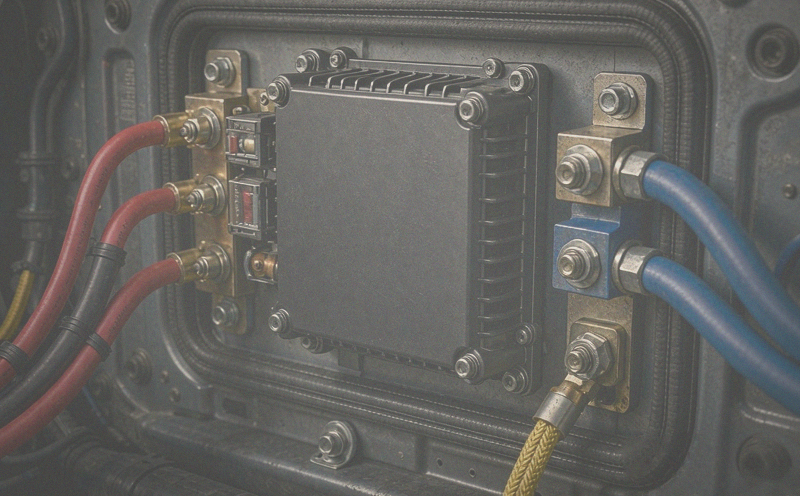
Two thermal decisions decide whether a lithium house bank survives its first winter. The first is placement. Putting the batteries in an enclosed compartment next to the inverter is not laziness about cable length, it is thermal design: the inverter's waste heat keeps the cells a few degrees warmer in service, lithium accepts charge more readily when warm, and short cable runs remove the last few watts of loss from the circuit.
The second is protection. LiFePO4 discharges comfortably well below freezing but must not be charged below 0 degrees Celsius, because lithium plating at the anode permanently removes capacity. A pack that is going to sit through a northern winter needs one of two things: a BMS that reads cell temperature and blocks charging until the pack warms, or a low-power heater pad that holds the enclosure above freezing. The reference build here uses an automatic domestic heating circuit that cuts in near 5 degrees Celsius and shuts off again around 10 degrees, which also means the water system never has to be winterised — an elegant side effect of solving the battery problem first.
Monitoring a Three-Bank System
With three banks, one shunt is not enough. Each system needs its own current measurement, and the operator needs a single dashboard that shows state of charge, voltage, current and temperature per bank, plus the state of every charger. This is where a three-bank build either becomes manageable or becomes a weekly mystery. If the auxiliary bank drifts out of balance or the DC-DC quietly stops, the first symptom is a slide-out that hesitates, and by then the fault is weeks old.
Modern system controllers solve this by aggregating every device on one bus, exposing the data locally on a display and remotely through a monitoring platform. Remote access is not a gimmick on a vehicle that travels: a geofenced alert that the house bank dropped 40 percent overnight tells you the fridge is running on inverter because the shore breaker tripped, long before the food does.
Sizing the Three Systems
Start from the house bank, because everything else is sized around it. Take a realistic daily consumption, not a brochure number: air conditioning at 1.8 kW for three hours, a fridge cycling at 1.2 kWh a day, lights, pumps, laptops and an induction hob for twenty minutes lands somewhere near 7.5 kWh. Against 30.7 kWh installed capacity, with a 90 percent usable window, that is roughly three and a half days of autonomy without sun.
| Bank | Configuração | Installed energy | Peak demand | Autonomy or reserve |
|---|
| House | 6 x 51.2 V 100 Ah in parallel, 16S LiFePO4 | 30.7 kWh | 5 kW continuous, 8 kW surge | About 3.5 days at 7.5 kWh per day |
| Auxiliary | 12.8 V 320 Ah LiFePO4 | 4.1 kWh | 3 kW for 90 seconds | About 50 slide cycles, or one emergency top-up |
| Chassis | 12 V 100 Ah AGM | 1.2 kWh | Cranking only | Isolated from house loads by design |
Five Mistakes That Break a Three-Bank Build
| Mistake | What actually happens | Correct approach |
|---|
| Running a 5 kW inverter from a 12 V house bank | 391 A through terminals and fuses, heat, voltage drop, tripping | Move domestic loads to a 48 V bank |
| Undersized DC-DC to the auxiliary bank | Bank never recovers, pump slows, converter overheats | Size for surge plus recharge current, allow ventilation |
| No pre-charge on a large inverter | Inrush current welds contactors or trips the BMS | Pre-charge resistor, or a BMS with pre-charge output |
| Charging LiFePO4 below 0 degrees Celsius | Lithium plating, permanent capacity loss, no warning | Temperature-sensed charge cutoff or a heater pad |
| One shunt for three banks | SOC drifts, one bank is silently abused | Per-bank current measurement, one dashboard |
Custom Packs From the Factory
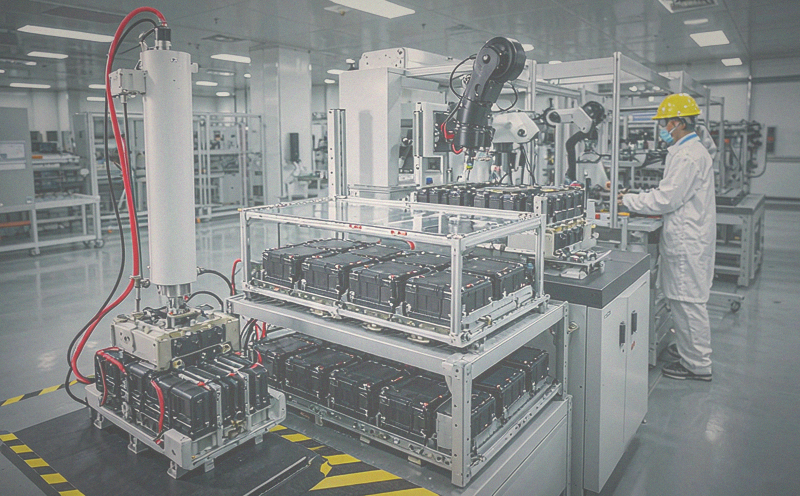
A three-bank RV is a custom build by definition, because the house bank has to fit an enclosure, the auxiliary pack has to deliver a surge the chassis cannot, and both have to report into whatever monitoring system the vehicle already uses. That is OEM and ODM work, not catalogue shopping. UFOPOWER manufactures LiFePO4 packs from 12 V to 48 V and beyond, with welded busbars, in-house battery management systems, temperature-sensed charge protection and CAN or RS485 communication for system integration.
Every pack leaves the line after capacity grading, high-current discharge testing and insulation checks, with a serial number tied to its test record. For a vehicle that will spend years off grid, that traceability matters more than a data sheet: when one battery in a parallel string starts to drift, the first question is always how it was tested when it was built.
If you are specifying a multi-bank RV, marine or expedition-vehicle system, send the load list, the enclosure dimensions and the existing charge sources, and UFOPOWER will propose a pack configuration that matches the rest of the vehicle instead of forcing the vehicle to match a catalogue number.


 EN
 AR
 DE
 ES
 FR
 JP
 KO
 PT
 RU
 Página inicial >
 Nov 09, 2026







 aplicativo WhatsApp