
 Oct 30, 2026
Product pages for lithium forklift batteries all make the same four promises: longer life, faster charging, no maintenance and a lower cost of ownership. They are broadly true, and they are also worthless as a buying decision, because they say nothing about whether a specific pack will fit your truck, survive your duty cycle or charge on your electrical supply.
What actually decides a lithium conversion is specification: voltage platform, usable energy in kWh, continuous and peak current, enclosure dimensions, connector type, charger power and controller communication. This guide walks through those items in the order they cause problems, so a fleet manager can read a lithium data sheet and know which numbers matter. UFOPOWER is a professional lithium battery manufacturer building factory-direct packs for 24V, 36V, 48V and 80V trucks, so the examples below come from real specification work rather than from a brochure.
| Typical Claim | What It Means Operationally | How to Verify It |
|---|---|---|
| Three to four times the cycle life of lead-acid | Fewer replacement events, so fewer capital cycles over a decade | Ask for the cycle count with the test conditions: depth of discharge, C-rate, temperature and the capacity retention criterion |
| Eighty percent charge in under an hour | Trucks return to work after a break instead of waiting for a full cycle | Check the charger kW against pack kWh, then confirm the site has that electrical capacity available |
| الصيانة الصفرية | No watering, cleaning or equalization labour in the shift plan | Confirm what inspection remains: terminal torque, connector wear, BMS log review, enclosure checks |
| Consistent power to the last cycle | Lift and travel speed hold up at hour seven of a shift | Ask for a discharge curve at your peak current, not just a nominal voltage figure |
None of these claims are false. The problem is that suppliers quote them without conditions, and conditions are exactly what determines whether the promise survives year three in a three-shift warehouse.
Voltage is the first filter, because the truck controller expects a specific window and will not negotiate. Match the platform before discussing capacity, price or anything else.
| Platform | Typical LiFePO4 Configuration | Typical Capacity Band | Typical Equipment |
|---|---|---|---|
| 24 فولت | 8S, 25.6V nominal | 100 to 300Ah | Pallet trucks, walkie stackers, small tow tractors |
| 36 فولت | 12S, 38.4V nominal | 150 to 400Ah | Older counterbalance trucks, order pickers, utility vehicles |
| 48 فولت | 15S, 48V nominal | 200 to 600Ah | 1.5 to 3.5 tonne counterbalance and reach trucks |
| 80 فولت | 25S, 80V nominal | 300 to 700Ah | Heavy counterbalance, high-throughput multi-shift sites, ground support equipment |
Two details trip people up. First, a lithium pack's nominal voltage is not the same number as the lead-acid pack it replaces, even on the same "36V" or "48V" label, because cell counts differ. Second, a truck designed around lead-acid may treat a slightly higher nominal voltage as full charge, so the BMS charge profile and the controller's voltage thresholds have to be agreed before the pack is built, not discovered after installation.
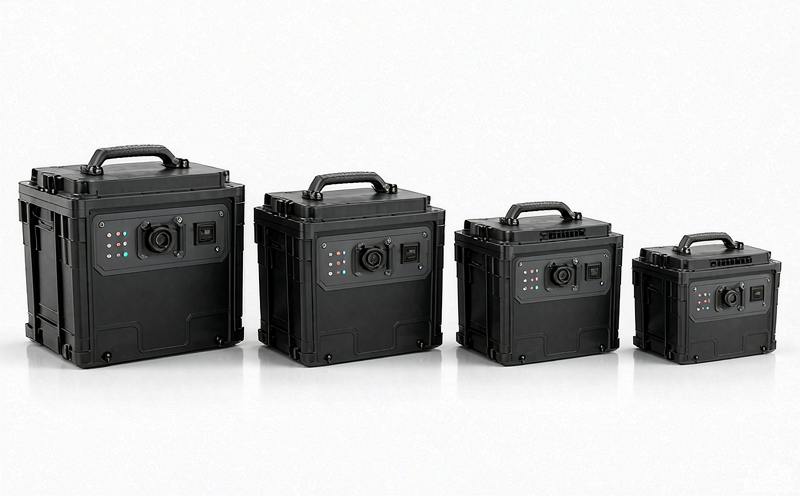
• Voltage window. Confirm the truck's acceptable range and the controller's low-voltage cutoff. A pack that sits outside the window will derate or refuse to start.
• Compartment dimensions. Length, width, height, plus cable exit direction, restraint points and lifting clearance. A pack that fits on paper but not past the counterweight is a return shipment.
• Weight and ballast. Lithium is lighter than the lead-acid block it replaces, and on counterbalance trucks that mass is part of the stability envelope. Decide on ballast and data plate updates in the specification, not on installation day.
• Connector and cabling. Connector type, cable length and bend radius, and whether the truck uses a separate charging port. Adapters exist, but every extra joint is a heat point.
• Charger compatibility. The charger must follow the pack's profile and, where supported, communicate with the BMS. A lead-acid charger with the same connector is not the same charger.
• Communication. CAN or RS485 so the truck displays state of charge and derates gradually rather than cutting power mid-aisle.
An Ah figure on its own says very little, because it only becomes energy when multiplied by voltage, and it only becomes usable energy when multiplied by the depth of discharge you plan to run. A 48V 400Ah pack holds about 19.2 kWh at nameplate; a lead-acid pack of the same 400Ah is normally limited to roughly half of that in daily use, which is why a lithium pack can often be smaller than the pack it replaces and still finish the shift.
Start from the truck's measured consumption per hour, multiply by the longest run between charges, and add margin for cold, attachments and aging. Then check the current side: continuous and peak amps must cover simultaneous lift and travel, because a pack that fits the energy budget but trips on current will spend its life in BMS protection.
The claim is achievable, but it is a system property rather than a battery property. Returning 80 percent of a 19.2 kWh pack means delivering roughly 15.4 kWh in under an hour, so the charger has to sustain more than 15 kW into the pack, plus losses. That is close to 0.8C on a 400Ah pack, and it changes three things: the charger specification, the site's spare electrical capacity and the pack's thermal design.
Most warehouses do not need that. A 0.3C charger placed where drivers already stop, used during breaks and shift changes, usually removes the need for a full cycle in the first place. The fast charger is worth its cost when a truck must return to a full shift in under an hour, not merely because the data sheet lists the capability.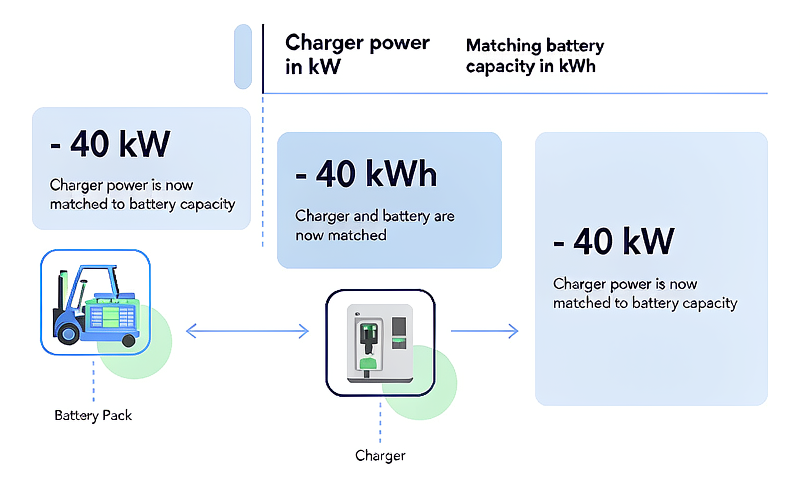
| Truck Type | Specification Priority |
|---|---|
| Counterbalance trucks | Peak current for lift plus travel, ballast and data plate, 48V or 80V depending on capacity class |
| Reach trucks | Compartment height, weight distribution and mast current draw at height |
| Pallet jacks and walkie stackers | 24V platform, low capacity, simple charging between tasks |
| Order pickers | Long low-current shifts, opportunity charging at fixed pick faces |
| Narrow aisle trucks | Enclosure width and lateral clearance, voltage stability for precise positioning |
| Cold storage | Low-temperature charge protection, pack heating where charging happens below freezing, condensation-safe enclosure |
Distribution centres and manufacturing plants usually run a mix of these, which is why a fleet conversion is better planned by truck class than by purchase order. Converting the high-utilisation counterbalance trucks first and leaving light-duty units on lead-acid often produces the fastest payback.
• Chemistry. LiFePO4 (LFP) is the standard choice in material handling because its thermal behaviour is more forgiving than higher-energy nickel chemistries.
• BMS scope. Cell-level over-voltage and under-voltage, over-current, temperature monitoring, low-temperature charge cutoff and cell balancing, with an exportable event log.
• Documentation. UN38.3 transport test reports and IEC 62619 cell and pack reports for your compliance file.
• Enclosure. IP rating appropriate to wash-down or dust, plus mechanical restraint tested for dock-plate shock.
• Service life expectation. Makers of material handling lithium packs commonly rate them at seven to ten years, and that figure depends on depth of discharge, temperature and charging habits rather than on the chemistry alone. Ask for the assumptions behind the number.
UFOPOWER is a professional lithium battery manufacturer producing forklift packs factory-direct on in-house lines. Packs are built to the truck rather than pulled from a fixed catalogue, which matters most in retrofits where the compartment was designed for a lead-acid block.
• Voltage platforms. 24V, 36V, 48V and 80V, with capacity derived from measured truck-hour consumption.
• Mechanical fit. Enclosure dimensions, restraint points, counterweight blocks and connectors matched to the existing compartment.
• BMS and communication. Protection thresholds set for the application, with CAN or RS485 protocol configured to the truck controller.
• OEM and ODM. Sample build and validation, then volume production with consistent cell sourcing and batch traceability.
• Factory testing. Capacity, internal resistance, charge and discharge behaviour and enclosure sealing checked on every unit before shipment.
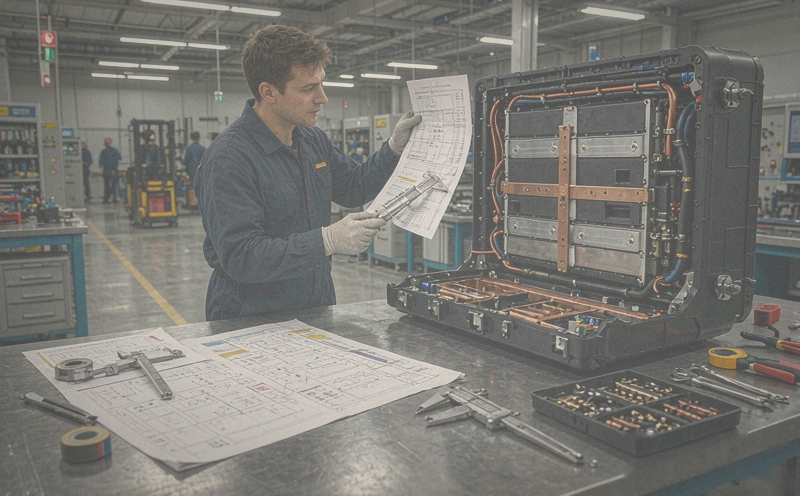
If you are comparing lithium packs for a fleet, the fastest way to cut through the marketing is to send the truck model, compartment dimensions, peak lift load and shift pattern. UFOPOWER will return a specification in kWh, amps and millimetres, which is the only format a purchase decision can actually be made in.
What voltage lithium forklift battery do I need?
Can a lithium battery be a drop-in replacement for my lead-acid battery?
How long does a lithium forklift battery last?
Is it true that a lithium forklift battery charges to 80 percent in under an hour?
Do lithium forklift batteries need a special charger?
How do I size the capacity correctly?


 واتساب
 EN
 AR
 DE
 ES
 FR
 JP
 KO
 PT
 RU
 الصفحة الرئيسية >